

It is 1997. You type a question into AltaVista and get back a wall of blue links that may or may not have anything to do with what you asked. Somewhere in the world, two Stanford grad students are building something in a garage that will change everything. Nobody knows it yet.
This is the story of how search went from those early keyword-matching experiments to AI systems that read the entire internet and answer your question before you finish typing it. It covers three decades of algorithm updates, billion-dollar shifts in strategy, and an industry that has had to reinvent itself at every turn. If you run a business that depends on being found online, understanding this history is not optional. It is the foundation for every smart decision you will make about SEO going forward.
How Search Engines Started: The First Search Engines (1994 to 1999)
Before Google, there was chaos. Beautiful, disorganized, wild-west chaos.
The first search engine that most people would recognize was Yahoo! Directory, launched in 1994. Except it was not really a search engine. It was a phone book. Actual humans read websites and sorted them into categories. If you wanted your site listed, you submitted it and waited for a person to review it. The entire indexable web had roughly 10,000 websites. Today, Google indexes over 400 billion pages.
AltaVista launched in 1995 and was the first engine to crawl and index a significant portion of the web automatically. It processed 13 million queries per day by 1997, which felt enormous at the time. For context, Google now handles over 8.5 billion searches per day.
Then came Google. Larry Page and Sergey Brin published their PageRank paper in 1998, and the core idea was deceptively simple: a link from one website to another is a vote of confidence. More votes from important sites means your page is more important. It sounds obvious now. At the time, it was revolutionary.
SEO in this era was barely a concept. If you wanted to rank, you stuffed your keywords into the page 47 times, made the text the same color as the background so humans could not see it, and submitted your URL to every directory you could find. It worked. The bar was underground.
"I started building websites in 2004, and even then you could still see the fingerprints of the 90s everywhere. Pages with invisible keyword text, link exchanges that were basically Ponzi schemes for PageRank. The early internet was the Wild West, and SEO was the guy selling snake oil from the back of a wagon."
Matt Russell, Co-Founder and Creative Director
How SEO Worked in the Early Days: Keyword Stuffing and Link Farms (2000 to 2010)
Google won the search engine war by 2004. Not because it had the best marketing. Because it returned better results. By 2006, "google" had become a verb. The company controlled over 60% of US search traffic and was climbing.
This was the golden age of SEO manipulation. The tactics that worked were, in hindsight, absurd:
- Keyword stuffing: Repeat your target keyword until the page reads like a broken record. "Best pizza Chicago best pizza Chicago best pizza Chicago." Google ranked it.
- Link farms: Networks of thousands of sites that existed solely to link to each other. No content. No visitors. Just links inflating PageRank like a financial bubble.
- Article spinning: Take one article, run it through software that swaps synonyms, publish 500 "unique" versions across 500 domains. Each one links back to your site.
- Exact match domains: Buy best-pizza-chicago.com and you were halfway to ranking number one before you published a single word.
Businesses spent thousands on these tactics. Agencies built entire business models around them. It was an arms race between spammers and Google, and for most of this decade, the spammers were winning.
Google fought back with incremental updates, but nothing stuck. The spam kept scaling. Revenue from search ads kept growing. Something had to give.
Key Milestones: 2000 to 2010
The Biggest Google Algorithm Updates That Changed SEO (2011 to 2015)
Then Google dropped the hammer. Multiple hammers, actually. In rapid succession.
Panda (February 2011) targeted thin, low-quality content. Content farms that had been printing money suddenly lost 50% or more of their traffic overnight. Demand Media, the largest content farm, saw its stock price drop 40% in two months. The message was clear: Google was done tolerating garbage.
Penguin (April 2012) went after manipulative link building. Link farms, paid links, and spammy anchor text were no longer shortcuts to the top. They were now liabilities. Entire SEO agencies that had built their reputation on link schemes went out of business in a single quarter.
The SEO industry had its first real existential crisis. The tactics that had worked for a decade were now penalties. Businesses that had invested heavily in spam-based SEO watched their traffic evaporate. It was painful. It was also necessary.
Hummingbird (August 2013) was quieter but arguably more important. For the first time, Google could understand the meaning behind a search query, not just match keywords. Search "what is the best place to eat near the Eiffel Tower" and Google no longer just looked for pages containing those exact words. It understood you wanted restaurant recommendations near a landmark in Paris.
Then came RankBrain (October 2015). Machine learning entered the algorithm. RankBrain could process queries Google had never seen before (15% of all daily searches are brand new) and figure out what the user probably meant. Google confirmed it was the third most important ranking factor. The era of AI-assisted search had quietly begun.
"The shift from Penguin to RankBrain is the moment SEO stopped being a technical trick and became a legitimate marketing discipline. Before 2012, you could game the system without understanding your customer at all. After RankBrain, the best SEO strategy became: actually answer the question better than anyone else. That is still true today."
Leo Speaks, Partner and Business Development
How Does SEO Work Now? Mobile-First, Voice Search, and BERT (2015 to 2019)
In 2015, mobile searches surpassed desktop searches for the first time. Google responded with Mobilegeddon (April 2015), an update that penalized sites not optimized for mobile. Then came Mobile-First Indexing (2018), which meant Google now crawled and ranked your mobile site, not your desktop site. If your mobile experience was bad, your rankings suffered regardless of how polished your desktop site looked.
Voice search entered the picture. By 2019, 27% of the global online population used voice search on mobile. People stopped typing "best Italian restaurant Seattle" and started asking "Hey Google, where should I get pasta near me?" This forced a shift toward conversational, natural language content.
Then BERT (October 2019) arrived, and it was the biggest leap in search understanding in five years. BERT (Bidirectional Encoder Representations from Transformers, for those keeping score at home) helped Google understand context in both directions of a sentence. The word "to" in "flights from Seattle to Boise" versus "flights from Boise to Seattle" now meant completely different things. Within a year, BERT was processing nearly every English-language search query.
By the end of this era, Google was no longer a keyword-matching machine. It was a language-understanding system. And SEO professionals who had adapted were thriving. Those who had not were writing angry blog posts about how SEO was dead. (Spoiler: it was not.)
The Future of SEO: AI Overviews, Zero-Click Searches, and GEO (2020 to 2026)
If the previous decade was about Google getting smarter, the 2020s are about search getting replaced. Or at least, dramatically reimagined.
MUM (May 2021) arrived as Google's most powerful language model yet. Built on a transformer architecture like BERT, MUM was 1,000 times more powerful. It could understand and generate language across 75 languages and process text, images, and eventually video simultaneously.
Then ChatGPT launched in November 2022, and the world changed overnight. Within five days, it had one million users. Within two months, 100 million. For the first time, people had a viable alternative to typing a query into Google and clicking through blue links. You could just ask a question and get a direct, conversational answer.
Google responded with AI Overviews (originally called SGE), which rolled out broadly in 2024 and 2025. These are AI-generated summaries that appear at the top of search results, answering the user's question directly. By early 2026, AI Overviews appear on roughly 25% of search queries, and searches that trigger them show an 83% zero-click rate. That means 83 out of 100 people get their answer without ever clicking a website.
The numbers tell a stark story:
Search by the Numbers (2026)
How the search landscape looks right now.
Sources: Semrush, Conductor, Statcounter, OpenAI (2025-2026 data)
This is where Generative Engine Optimization (GEO) enters the picture. Traditional SEO optimizes for rankings on a results page. GEO optimizes for citations inside AI-generated answers. Different goal, different tactics, complementary strategy. Our GEO service page breaks down how we approach this for clients.
The SEO services market is now worth an estimated $84 billion globally in 2026, projected to reach $148 billion by 2031. The industry is not shrinking. It is evolving, again, the way it always has. The difference is that this time, the evolution is happening faster than ever.
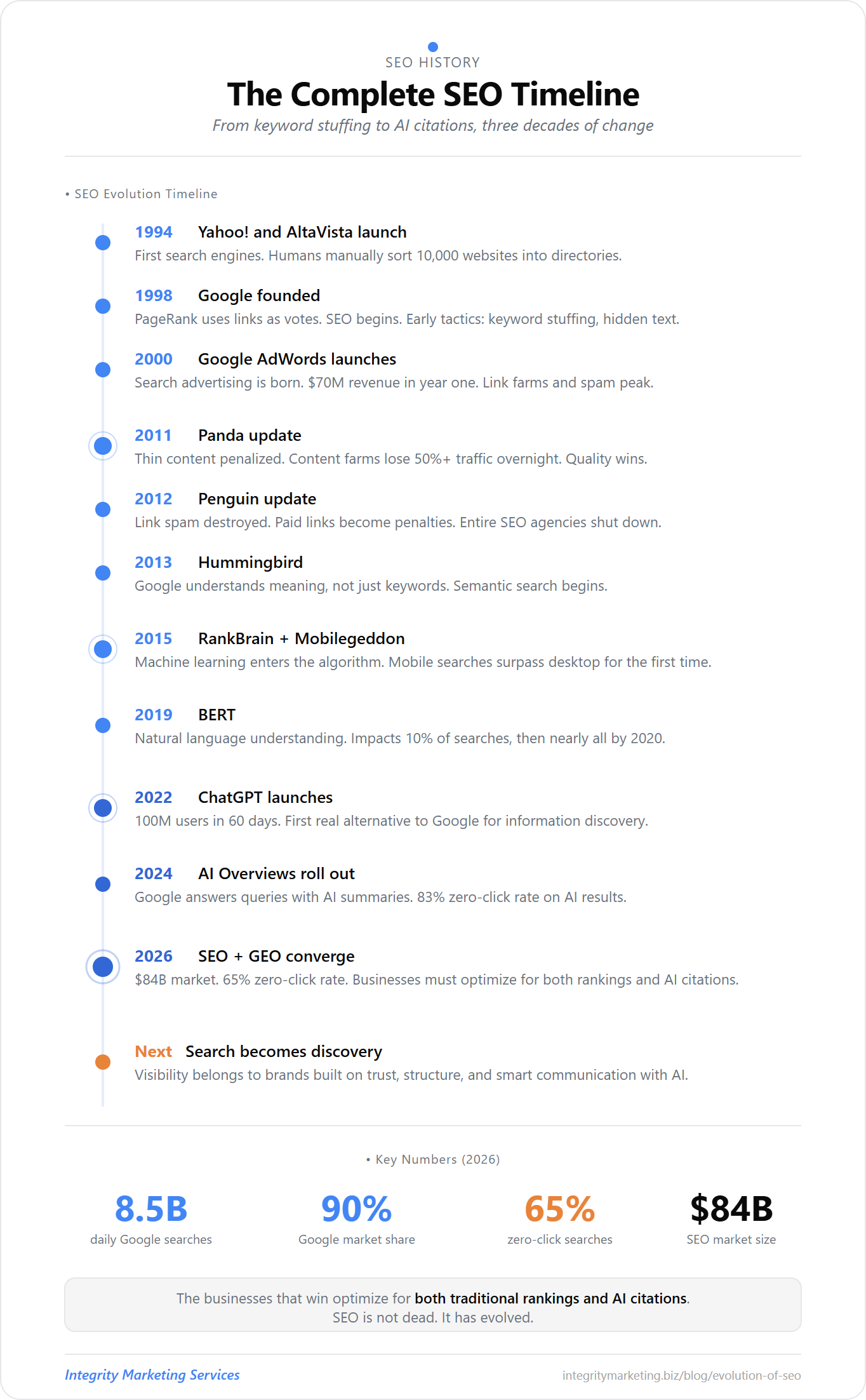
The Complete SEO Evolution Timeline
Click any era to explore key events, stats, and turning points.
1994 to 1999
The Dawn of Search
Yahoo Directory, AltaVista, Google founded. 10,000 websites to 3 million.
10K
Websites (1994)
13M
Daily queries (AltaVista)
$25M
Google's first funding
Key events: Yahoo launches (1994). AltaVista goes live (1995). Google.com registers (1997). PageRank paper published (1998). SEO tactics: keyword stuffing, hidden text, directory submissions.
2000 to 2010
The Wild West
Google dominates. AdWords launches. Link farms and keyword stuffing peak.
72%
Google market share (2009)
$70M
AdWords year-one revenue
1B+
Daily searches (2009)
Key events: AdWords (2000). Google IPO at $85/share (2004). Universal Search (2007). Bing launches (2009). Dominant tactics: link farms, article spinning, exact-match domains, paid links.
2011 to 2015
Google Gets Smart
Panda, Penguin, Hummingbird, RankBrain. Spam dies. Quality wins.
12%
Sites hit by Panda
-40%
Content farm stock crash
15%
New queries daily (RankBrain)
Key events: Panda (Feb 2011). Penguin (Apr 2012). Hummingbird (Aug 2013). Mobilegeddon (Apr 2015). RankBrain (Oct 2015). The pivot: quality content and earned links replace manipulation.
2015 to 2019
The Mobile and Intent Era
Mobile-first indexing. BERT understands language. Voice search grows.
60%
Searches on mobile (2019)
10%
Searches impacted by BERT
27%
Users on voice search
Key events: Mobile-first indexing (2018). BERT (Oct 2019). Featured snippets expansion. Voice search 27% of mobile users. The pivot: intent understanding and mobile experience trump keyword matching.
2020 to 2026
The AI Revolution
ChatGPT. AI Overviews. GEO. Search is no longer just links.
8.5B
Google searches/day
$225B
Google Search revenue (2025)
750M
ChatGPT monthly users
Key events: MUM (2021). ChatGPT launch (Nov 2022). AI Overviews rollout (2024). GEO emerges as discipline (2025). Google API leak confirms click signals (May 2024). The pivot: optimize for AI citations, not just rankings.
Search Engine Market Share: Google vs AI Search in 2026
One of the most fascinating aspects of this evolution is how the competitive landscape has shifted. In 1998, there were dozens of search engines competing for users. By 2010, Google owned the market so completely that regulators started paying attention. Now, in 2026, the monopoly is finally showing cracks.
Search Engine Market Share
AI platforms handle 2-3% of search-like queries but do not appear in traditional market share data. Actual influence on information discovery is much larger.
Google still processes 8.5 billion searches per day and generated $224.5 billion in search revenue in 2025. But the trajectory matters more than the snapshot. Combined traffic to AI platforms like ChatGPT and Perplexity surged 225% from 2024 to 2025. Google's market share dipped below 90% for the first time in a decade in March 2025. The castle walls are holding, but for the first time in 20 years, there are real siege engines outside the gates.
SEO Trends in 2026: What Businesses Need to Do Now
If you have read this far, you might be thinking: "This is interesting history, but what do I actually do about it?" Fair question. Here is the practical takeaway.
Every major shift in search history followed the same pattern: a new technology created new opportunities, early adopters won disproportionate market share, and everyone else spent years catching up. The businesses that invested in quality content before Panda were rewarded. The ones that built real authority before Penguin were protected. The ones that went mobile-first before Google forced it were ahead.
Right now, SEO is still the highest-ROI marketing channel for most businesses. Organic search drives roughly 53% of all website traffic. That has not changed. What has changed is that you now need to optimize for two systems simultaneously: traditional search rankings and AI citation.
That means:
- Your content needs to be structured for both humans and machines. Clear headings, schema markup, and direct answers to specific questions. This is not optional anymore.
- Authority signals matter more than ever. AI systems cite sources they trust. That trust comes from backlinks, brand mentions, expert authorship, and consistent, accurate information across the web.
- Technical SEO is non-negotiable. Site speed, crawlability, structured data, and Core Web Vitals directly impact whether your content gets indexed, ranked, and cited.
- Local businesses have an advantage. AI Overviews tend to defer to local results for service queries. If your local SEO is strong, you are positioned well for both traditional and AI search.
The businesses that win in 2026 and beyond will be the ones that treat SEO and GEO as complementary channels, not competing ones. Traditional SEO builds the foundation. GEO ensures that foundation gets cited by the AI systems that are reshaping how people discover information.
"I have been doing SEO professionally for eight years now, and the one constant is change. Every year someone publishes an article asking if SEO is dead. Every year the answer is the same: no, but the SEO that worked two years ago might be. The core principle has never changed. Understand what your customer is looking for, create the best possible answer, and make it easy for search engines to find and trust. That was true in 2018 and it is true in 2026. The tools and tactics change. The principle does not."
Dylan Axelson, SEO Director
Where Does Your SEO Strategy Stand?
Answer 5 quick questions to find out which era your strategy belongs to.
Your SEO strategy is in the
Is SEO Dead? Why the Core Principle Has Never Changed
Thirty years of search engine evolution, dozens of major algorithm updates, the rise of AI, and the birth of entirely new optimization disciplines. Through all of it, one thing has never changed: the businesses that succeed in search are the ones that genuinely help their customers.
Google has spent three decades and billions of dollars trying to build a system that rewards useful, trustworthy content and punishes manipulation. They are getting closer every year. The trajectory only goes in one direction. If you align your strategy with what is actually helpful, the algorithm updates become tailwinds, not threats.
That is not a platitude. That is the lesson of 30 years of data. The companies that were hurt by Panda were producing thin content. The ones hurt by Penguin were buying links. The ones struggling with AI Overviews are the ones whose content can be summarized in a sentence because it was never more than surface-level to begin with.
The companies that thrive? They create content worth citing. They build websites worth visiting. They earn trust, one customer at a time. And they keep adapting, because the only thing more constant than change in search is the reward for being genuinely good at what you do.
If you want to see how long SEO takes to produce results or learn how we built April AI, our proprietary SEO system, those guides go deeper into the practical side of modern SEO strategy.
Sources and Further Reading
This article draws on data from the following sources. We encourage you to explore them for deeper dives into specific topics:
- Google Search Central Blog: Official documentation of algorithm updates and best practices
- Search Engine Journal: Google Algorithm History: Comprehensive timeline of every confirmed update
- Semrush Zero-Click Search Study: Data on how search behavior is shifting
- OpenAI: ChatGPT Search: How AI search alternatives are entering the market
Frequently Asked Questions
SEO (Search Engine Optimization) is the practice of optimizing websites to rank higher in search engine results. It has evolved from simple keyword stuffing in the 1990s to a complex discipline involving content quality, technical performance, user experience, and now AI citation optimization. Modern SEO requires understanding both traditional ranking factors and how AI systems select and cite sources.
SEO as a practice began in the mid-1990s when webmasters realized they could influence how search engines ranked their pages. The term "search engine optimization" was first used around 1997. Early tactics included submitting URLs to directories, keyword stuffing, and meta tag optimization. The discipline became professionalized in the early 2000s as Google became the dominant search engine.
Archie, created in 1990 by Alan Emtage at McGill University, is generally considered the first search engine. It indexed FTP file listings, not web pages. The first web search engine was W3Catalog (1993), followed by WebCrawler (1994), which was the first to index full page text. Yahoo Directory (1994) and AltaVista (1995) were the first search engines most people used regularly.
Google fundamentally changed SEO by introducing PageRank, which used links as votes of authority. This shifted SEO from pure on-page keyword optimization to a combination of content quality and off-site authority. Over the following decades, Google introduced hundreds of algorithm updates (Panda, Penguin, Hummingbird, RankBrain, BERT) that progressively rewarded genuine quality and punished manipulation, transforming SEO from a technical trick into a legitimate marketing discipline.
The most impactful Google algorithm updates are: Panda (2011, targeted thin content), Penguin (2012, targeted spammy links), Hummingbird (2013, semantic understanding), Mobilegeddon (2015, mobile-friendliness), RankBrain (2015, machine learning), BERT (2019, natural language understanding), MUM (2021, multimodal understanding), and the Helpful Content updates (2022-2024, which were folded into the core algorithm). Google makes thousands of changes per year, but these named updates represent the biggest shifts.
SEO optimizes for rankings on search engine results pages. GEO (Generative Engine Optimization) optimizes for citations inside AI-generated answers from systems like Google AI Overviews, ChatGPT, and Perplexity. SEO focuses on keywords, backlinks, and technical factors. GEO focuses on structured data, entity clarity, citation-worthiness, and content that AI systems can confidently reference. Most businesses need both. Read our full GEO service page.
Yes, but their role has changed. Keywords are no longer about exact-match repetition. Google understands synonyms, intent, and context through models like BERT and MUM. Modern keyword strategy focuses on topic clusters and search intent rather than individual keyword density. You still need to know what your audience is searching for, but how you incorporate those terms into content is far more natural and intent-driven than it was even five years ago.
Zero-click searches are queries where the user gets their answer directly on the search results page without clicking through to any website. This includes featured snippets, knowledge panels, AI Overviews, and direct answers. As of 2026, approximately 65% of Google searches end without a click, and that number rises to 83% for queries that trigger AI Overviews. This is why optimizing for visibility and brand mentions, not just clicks, is increasingly important.
AI Overviews appear at the top of roughly 25% of Google search results in 2026, providing AI-generated summaries that answer the query directly. They reduce click-through rates to organic results by an estimated 61%. However, being cited as a source within an AI Overview can actually increase your visibility and authority. The key is creating content that is structured, authoritative, and specific enough that AI systems cite you as a trusted source rather than summarizing away your traffic.
No. The SEO services market reached $84 billion in 2026 and is projected to hit $148 billion by 2031. Organic search still drives 53% of all website traffic. What has changed is that SEO now requires a broader approach that includes AI citation optimization alongside traditional ranking tactics. The businesses declaring SEO dead are typically the ones still using outdated tactics. Modern SEO that adapts to AI search is more valuable than ever.
Generative Engine Optimization (GEO) is the practice of optimizing your online presence to be cited by AI-powered search systems including Google AI Overviews, ChatGPT, Perplexity, and Claude. It involves structured data implementation, entity optimization, content restructuring for AI readability, and building the authority signals that make AI systems confident enough to cite your business. Learn more in our our GEO services.
Start by maintaining strong traditional SEO fundamentals: quality content, technical health, and authoritative backlinks. Then layer in GEO tactics: implement comprehensive schema markup, structure content with clear question-and-answer formats, build topical authority through content clusters, and ensure your brand information is consistent across the web. Focus on creating content that is specific and data-driven enough that AI cannot easily summarize it away. Consider a free SEO audit to identify where your strategy stands today.
Get cited by AI
Want your business recommended by AI search?
Generative Engine Optimization is the next layer of search. We optimize your content to be cited by ChatGPT, Google AI Overviews, and Perplexity.