

Why Microsoft Ads Deserves Your Attention
Most advertisers pour their entire budget into Google Ads and never look beyond it. That is a mistake. Microsoft Ads (formerly Bing Ads) reaches a professional, high-income audience through the Microsoft Search Network, which includes Bing, Yahoo, AOL, MSN, and Microsoft Edge. For B2B companies, this audience is gold.
The platform consistently delivers lower cost-per-click than Google because fewer advertisers compete for the same keywords. Less competition means more visibility for your budget. And because the Microsoft ecosystem is embedded in corporate environments (Windows, Office, Outlook), the users searching on Bing skew toward employed professionals and decision-makers.
"In my experience managing paid search across industries, Microsoft Ads consistently outperforms Google on cost efficiency, with CPCs frequently running 30% lower. The brands winning right now are not just on Google. They are leveraging Microsoft's distinct audience to stretch their budgets further and capture demand their competitors are missing."
Brock Olsen, Paid Media Strategist
How Microsoft Ads Works
Microsoft Ads operates on the same auction-based model as Google Ads. You bid on keywords, and when a user searches for one of those keywords, the platform runs an auction to determine which ads appear. The winners are decided by a combination of bid amount, ad relevance, and quality score.
The key difference is where those ads show up. When you advertise with Microsoft Ads, your campaigns can appear across:
- Bing: Microsoft's primary search engine, integrated into Windows and used as the default in many corporate environments.
- Yahoo and AOL: Long-standing search partners that expand your reach beyond Bing alone.
- MSN and Microsoft Edge: Microsoft's web portal and browser, both of which default to Bing for search.
This network captures millions of users who are not reachable through Google. For B2B advertisers, those users tend to be exactly the kind of prospects you want: professionals searching during work hours on corporate devices.
The LinkedIn Profile Targeting Advantage
This is the feature that makes Microsoft Ads uniquely powerful for B2B. No other search platform offers it.
Microsoft Ads integrates directly with LinkedIn data, allowing you to layer professional targeting on top of your keyword campaigns. Instead of just targeting what people search for, you can also target who they are. You can refine your audience by:
- Job title: Reach specific roles like "Chief Technology Officer," "Marketing Director," or "Procurement Manager."
- Company: Target employees at specific companies, whether they are key accounts, competitors, or enterprise prospects.
- Industry: Focus your ads on professionals in verticals like information technology, manufacturing, financial services, or healthcare.
This level of precision changes the economics of paid search entirely. Instead of paying for clicks from anyone who types your keyword, you pay for clicks from the specific decision-makers who can actually buy what you sell. The result is higher lead quality and a stronger return on every dollar spent.
Microsoft Ads vs. Google Ads
Choosing between the two is not really the right framing. Most businesses that run Google Ads successfully should also be testing Microsoft Ads. But understanding the differences helps you allocate budget and set expectations.
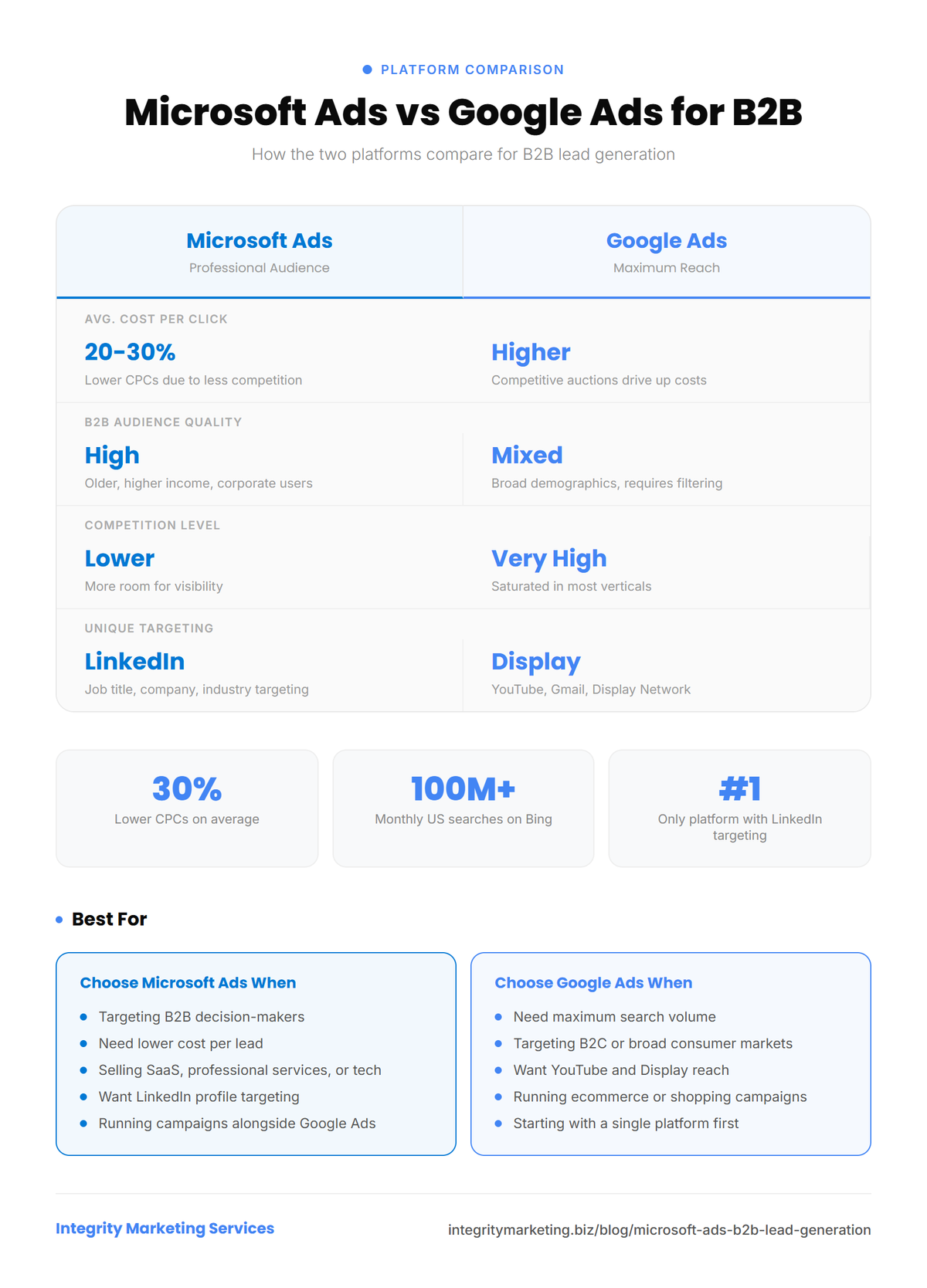
| Factor | Microsoft Ads | Google Ads |
|---|---|---|
| Audience | Older, higher income, strong B2B presence | Broader, all demographics |
| Cost per click | Often 20-30% lower | Higher, especially in competitive verticals |
| Competition | Lower, more room for visibility | Extremely high in most industries |
| B2B lead quality | Often higher due to professional audience + LinkedIn targeting | Can be high, but requires more filtering |
| Unique advantage | LinkedIn Profile Targeting | Massive reach + YouTube/Display Network |
The platforms complement each other. Google gives you scale. Microsoft gives you precision and cost efficiency. Running both lets you capture demand across the entire search landscape while keeping your blended cost per lead in check.
Who Benefits Most From Microsoft Ads
While many businesses can find value on the platform, certain profiles are uniquely positioned to capitalize on Microsoft's strengths:
- B2B companies: Any business selling to other businesses can leverage LinkedIn targeting to reach the people who actually sign purchase orders.
- SaaS and technology companies: The platform is heavily used by tech professionals. If you are selling software or IT services, your audience is already there.
- Professional services: Firms in finance, law, accounting, and consulting can connect with an affluent, credentialed audience actively seeking expertise.
- Manufacturing companies: Targeting engineers, procurement managers, and executives in specific industries to generate high-value leads.
- Local service providers targeting commercial clients: Contractors and service businesses pursuing professional or commercial accounts can stand out in a less crowded marketplace.
Building a Winning Campaign Strategy
A successful Microsoft Ads campaign requires the same rigor as any paid search program. The difference is in how you leverage the platform's unique strengths.
Start with high-intent keywords
Focus on keywords that signal purchasing intent, not just awareness. Long-tail keywords with commercial modifiers ("enterprise project management software pricing" vs. "project management") cost less and convert at higher rates.
Layer LinkedIn targeting on every campaign
This is where most advertisers leave money on the table. Combine your keyword strategy with job title, industry, or company targeting to ensure your ads reach qualified prospects. A click from a VP of Operations searching "fleet management software" is worth ten clicks from random searchers.
Optimize your bidding strategy
Start with manual bidding to understand your cost landscape, then move to automated strategies once you have enough conversion data. The lower competition on Microsoft Ads means you can often achieve top-of-page positions at a fraction of what you would pay on Google.
Align your landing pages
A click means nothing if the landing page does not deliver. Every ad group should point to a dedicated landing page that matches the ad's message and has a single, clear call to action. Generic homepages kill conversion rates.
Common Mistakes to Avoid
Transitioning to Microsoft Ads requires a specific approach. These are the errors we see most often:
- Copying Google campaigns directly: You can import campaigns from Google Ads, but they need significant optimization. The audiences, competition levels, and keyword performance are different.
- Ignoring LinkedIn targeting: The single biggest missed opportunity. If you are running Microsoft Ads for B2B and not using LinkedIn Profile Targeting, you are leaving the platform's most powerful tool unused.
- Weak ad group segmentation: Lumping all keywords into one ad group leads to irrelevant ad copy and low quality scores. Tight segmentation means more relevant ads and lower costs.
- Sending traffic to your homepage: Every campaign needs a purpose-built landing page. Sending paid traffic to a general page wastes budget and frustrates users who clicked expecting something specific.
Our Approach to Microsoft Ads Management
At Integrity Marketing, we treat Microsoft Ads as a strategic channel for reaching high-value prospects, not an afterthought to Google. Our management covers the full lifecycle: keyword research and competitive analysis, campaign architecture and ad group segmentation, LinkedIn audience layering, ad copywriting and A/B testing, bid management and budget optimization, landing page alignment, and ongoing performance reporting.
Located in Kirkland, Washington, we operate at the heart of the Pacific Northwest tech hub. We understand the professional demographics of this region, from engineers in Redmond to tech executives in Bellevue, because we are part of the same community. That local insight helps us craft campaigns that resonate with B2B audiences in ways a remote agency simply cannot.
Frequently Asked Questions
Is Microsoft Ads effective for B2B lead generation?
Yes. Microsoft Ads is particularly effective for B2B campaigns because its audience skews toward professionals, business decision-makers, and corporate users. LinkedIn Profile Targeting lets you reach specific job titles, industries, and companies directly through the search platform.
How much does Microsoft Ads cost compared to Google Ads?
In most industries, Microsoft Ads delivers a lower cost per click than Google because there is less competition. Many of our clients see CPCs that are 20-30% lower, which makes it a cost-effective platform for generating high-quality leads.
Can I import my Google Ads campaigns into Microsoft Ads?
You can. Microsoft Ads has a built-in import tool for Google campaigns. However, imported campaigns almost always need optimization because keyword performance, audience behavior, and bidding dynamics differ between the platforms.
How long does it take to see results?
Most campaigns start generating clicks and leads within the first few weeks. Consistent, optimized performance typically takes 30 to 90 days as we test keywords, refine targeting, and improve landing pages based on real data.
What industries benefit most from Microsoft Ads?
B2B services, SaaS companies, professional services, manufacturing, and technology businesses see the strongest returns because of the platform's professional audience and LinkedIn-based targeting capabilities.
Stop wasting ad spend
Want to know if your Google Ads are working?
We audit over 100 accounts a year and find an average of 25% wasted spend. Get a free audit and see where your budget is really going.