

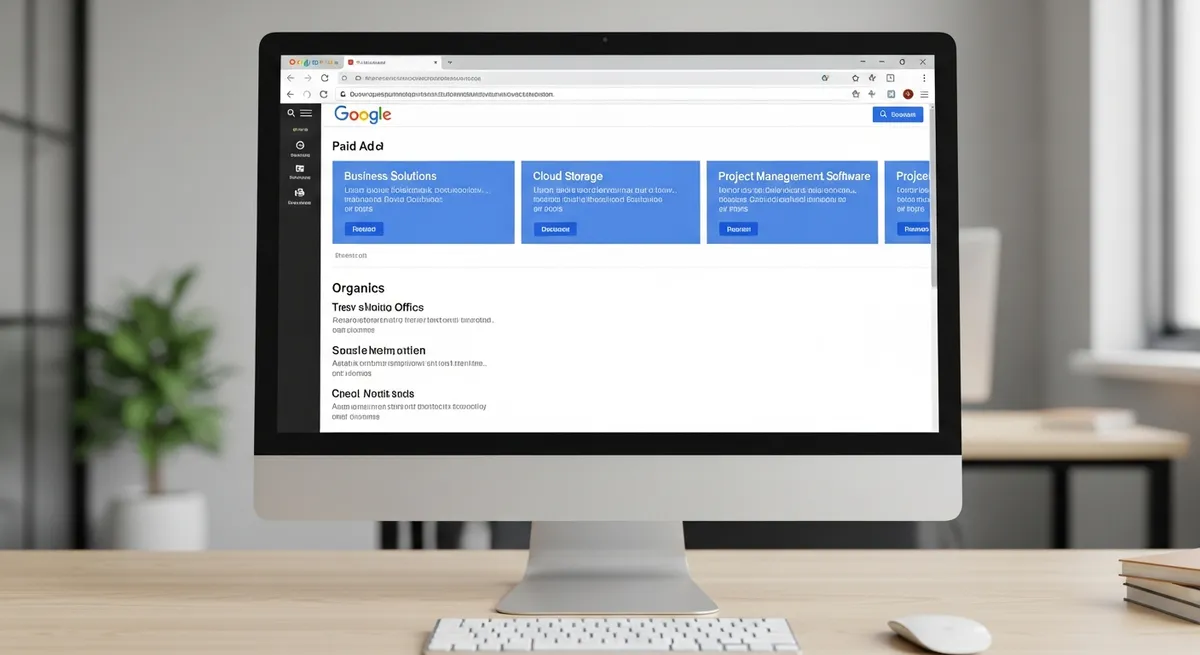
Google Ads is Google's paid advertising system. You bid on the words people type into search, and when someone searches one of them, Google runs an instant auction to decide which ads appear and in what order. You pay only when someone clicks. For a local service business, that means you can be at the top of the results for "emergency plumber near me" tomorrow morning, without waiting the months that organic ranking takes.
That is the definition. The more useful question, and the one this guide is actually about, is whether it will work for a business like yours. Google Ads can fill a schedule inside a week. It can also spend $3,000 a month and produce nothing. The difference is rarely the platform. It is whether the demand exists in your market, whether your margin per job can absorb what a lead costs in your trade, and whether anyone answers the phone when it rings.
Already running ads and not sure they are working? We will pull your account and tell you plainly what we see. Get a free Google Ads audit, no obligation.
How the auction actually works
Most explanations stop at "you bid on keywords," which leaves owners thinking the highest bidder wins. That is not how it works, and the difference matters to your budget.
When someone searches, Google scores every eligible ad on two things: your bid, and your Quality Score. Quality Score is Google's read on how relevant your ad and your landing page are to what the person actually searched. A business with a strong Quality Score can hold a higher position while paying less per click than a competitor bidding more.
This is the single most important thing to understand about the economics. Your cost per click is not set by what you are willing to pay. It is set by how well your account is built. Two roofers in the same city, bidding the same amount on the same keyword, can pay meaningfully different prices for the same click. The one sending traffic to a page about roofing in their city beats the one sending traffic to a generic homepage.
It also explains why "just raise the bids" is almost never the fix when an account is underperforming. Higher bids on a poorly structured account buy more expensive versions of the same bad clicks.
The four places your money can go
Google will happily sell you four different products under one login. They are not equally useful for a local service business, and the order below is roughly the order we recommend for most trades.
Search ads
Text ads on the results page, triggered by what someone typed. This is the highest intent traffic on the internet: someone searching "water heater replacement Kirkland" has a broken water heater. For most service businesses this is where the first dollar should go, and often where most of the budget stays.
Local Service Ads
A separate program that sits above the regular search ads and carries the Google Guaranteed badge. You pay per lead instead of per click, and Google screens you through a background and license check first. For plumbers, electricians, HVAC, roofers, and locksmiths, this frequently produces a lower cost per lead than standard search, and it is worth running alongside rather than instead. We cover the details in Local Service Ads management.
Performance Max
Google's automated campaign type that spreads budget across Search, Display, YouTube, Gmail, and Maps using its own targeting. It can work well for ecommerce with a clean product feed. For a local service business it tends to be opaque, hard to control, and quick to spend money on low-intent placements. We use it selectively, not by default.
Display and YouTube
Banner and video ads shown to people who are not searching for anything. These are awareness channels. They have a place once search demand is fully captured and you are trying to build recognition in a market, but they are the wrong first purchase for a business that needs calls this month.
What it actually costs
There are two numbers in every Google Ads budget, and conflating them is where most bad expectations start.
Ad spend goes to Google, billed directly to your card. For most local service businesses this starts around $1,500 to $5,000 a month depending on the trade and how competitive your market is.
Management is what you pay someone to build and run the account. Our Google Ads management starts at $750 a month, and the full breakdown is on our pricing page. We ask for a three month initial commitment, then month to month, because an account genuinely needs about that long to produce data worth acting on.
The number that actually matters, though, is neither of those. It is cost per lead, and it varies more than most owners expect. These are real figures from accounts we run, not averages we found somewhere.
Real accounts, not industry averages
What a lead actually costs, by trade
Cost per lead from five accounts we manage, across very different trades.
A number that would alarm the marine services owner is perfectly healthy for the manufacturer, because a single lead is worth vastly more in one than the other. So ask any agency for their range by trade, and be wary of one that answers with a single industry average.
So the honest answer to "what does Google Ads cost" is that it costs whatever a customer is worth to you, divided by how well the account is run. Which leads to the question you should be asking first.
How to tell whether it will work, before you spend
Four conditions decide this. If you can answer yes to all four, Google Ads will very likely work for you. If you cannot, spend the money elsewhere until you can.
1. People are already searching for what you sell
Google Ads captures existing demand. It does not create it. If nobody in your area is typing anything close to your service into Google, no budget or bidding strategy fixes that. This is checkable before you spend a dollar, and it is the first thing we look at.
2. Your margin per job can absorb the cost of a lead
Work out what one job is worth to you, then how many leads it takes to close one. If a roofing lead costs $59 and you close one in five, you are paying about $295 in advertising for a job worth several thousand. That works. If you sell a $120 service and close one lead in six, the same math does not.
3. Someone answers the phone quickly
This is the condition most owners underestimate, and it has nothing to do with advertising. Paid clicks arrive when the person is ready to hire. If the call goes to voicemail, they call the next business on the page, and you paid for the click anyway. Slow response is the most expensive habit in paid search.
4. The clicks land on a page built to convert
An ad's only job is to get someone to the page. The page has to do the rest. Sending paid traffic to a homepage that talks about your history, rather than a page about the specific service someone searched, is the most common structural waste we find in accounts we take over. It also drags down Quality Score, so you pay more per click for the privilege.
What the first 90 days should look like
Anyone promising results in week one is describing a spend, not a result. Here is a realistic shape.
The first two weeks are build and baseline: campaign structure, keyword research, negative keyword lists, conversion tracking that actually fires, and landing pages worth sending clicks to. Leads usually start arriving within the first week of launch, but they are not yet cheap or consistent.
Weeks three through eight are where the account earns its keep. Search term reports show what people actually typed, which is never quite what you targeted. Negatives get added, budget shifts toward the services converting best, and the wasteful segments get cut. Cost per lead should be trending down through this period, not holding flat.
By month three you should know your cost per lead by service, which campaigns deserve more budget, and what your real return looks like. That is the point at which a decision to continue or stop is an informed one.
For a sense of what disciplined work produces over time: for Allen Medical Aesthetics, competing on some of the most expensive keywords in local search, we rebuilt the site and the paid program together and cut cost per conversion by nearly four fifths while conversions more than quintupled on the same budget. The full case study is here.
Where the first budget usually gets wasted
Most accounts we inherit are losing money in the same few places. None of them are exotic.
Broad match keywords with no negative list, so a fencing company pays for "fence painting ideas." Conversion tracking that was never set up properly, which means every optimization decision after that is guesswork. One campaign covering every service, so the profitable work subsidizes the unprofitable. Ads pointing at the homepage. And location targeting set to "people interested in" your area rather than people physically in it, which quietly buys clicks from three states away.
We wrote up the full list in seven common Google Ads mistakes. If you are running ads now, that is the faster read.
Google Ads or SEO first?
They answer different questions. Google Ads answers "how do I get calls this month." SEO answers "how do I stop paying for every call in three years." Ads produce leads immediately and stop the day you stop paying. Organic rankings take months to build and keep working after the invoice ends.
For most businesses the honest answer is both, weighted by cash position. If you need work booked now, start with ads and add SEO once the schedule is stable. If you have steady work and are building for the next few years, start with SEO. We compared the two properly in SEO versus Google Ads.
Frequently Asked Questions
What is a Google Ads account?
It is the free login where you build and manage everything: campaigns, keywords, ad copy, budgets, and billing. Creating one costs nothing, and you only pay when your ads run and someone clicks. One account can hold many campaigns, which is how a business separates its services and locations.
How does Google Ads work, step by step?
You pick keywords, write ads, set a daily budget, and choose where geographically your ads can show. When someone searches one of your keywords, Google runs an auction weighing your bid against your Quality Score, and the winners appear above and below the organic results. You are charged only when someone clicks, never for the ad simply being seen.
Do Google Ads work for local businesses?
Yes, and local service businesses are among the best fits for the channel, because search intent maps so directly to hiring. Someone searching "emergency electrician near me" is not researching, they are hiring in the next hour. The businesses it does not work for are the ones with no existing search demand or with margins too thin to absorb the cost of a lead.
How much should I spend on Google Ads per month?
Most local service businesses need $1,500 to $5,000 a month in ad spend to gather usable data and hold a consistent presence, plus management on top. Below about $1,000 a month the account struggles to collect enough signal to optimize, and results stay erratic. Work backward from what a job is worth to you rather than picking a round number.
How quickly do Google Ads start working?
Ads can go live within a day of the account being built, and the first leads often arrive in the first week. Reliable performance takes longer. Expect roughly 90 days before cost per lead settles and you can judge the channel fairly.
Can I run Google Ads myself?
You can, and some owners do it well. The platform is designed to be usable without training, which is exactly the risk: it is also designed to spend your budget by default. The parts that decide whether the account makes money, negative keyword lists, conversion tracking, campaign structure, and search term review, are the parts Google does not prompt you to do. If you have several hours a week to give it, self-managing is viable. If you do not, the management fee usually costs less than the waste.
What is the difference between Google Ads and Local Service Ads?
Google Ads charges per click and gives you control over keywords, ad copy, and landing pages. Local Service Ads charge per lead, sit above the regular ads, and carry the Google Guaranteed badge after a background and license check. Most home service businesses should run both, since they capture different parts of the same results page.
What happens if I stop paying?
Your ads stop appearing the same day, and the leads stop with them. There is no residual benefit, which is the main structural difference from SEO. It is also why we recommend building organic visibility in parallel rather than renting all of your traffic indefinitely.
If you want a straight answer on whether Google Ads fits your business, we will look at your market and your numbers and tell you honestly, including when the answer is no. See how we manage Google Ads or start a conversation.
Stop wasting ad spend
Want to know if your Google Ads are working?
We audit over 100 accounts a year and find an average of 25% wasted spend. Get a free audit and see where your budget is really going.