

What PPC Advertising Is and Why It Works
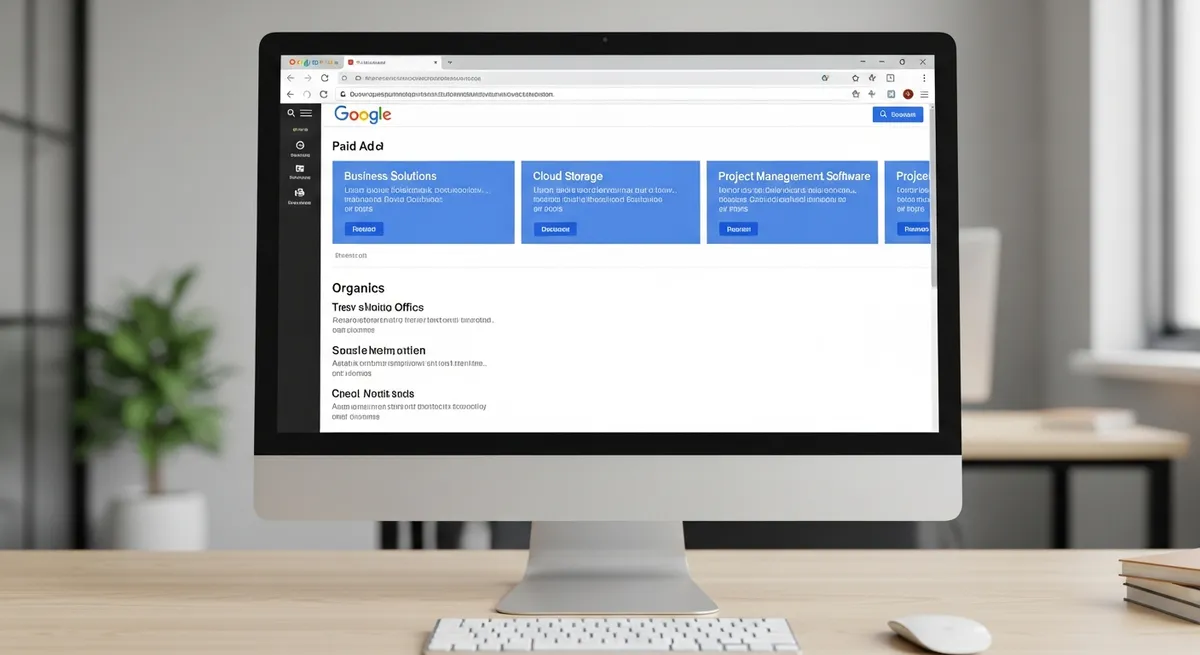
Pay-per-click advertising puts your business at the top of search results when people are actively looking for what you offer. You bid on keywords, and you pay only when someone clicks your ad. Instead of waiting months for organic rankings to build, PPC delivers qualified traffic from day one.
That immediacy is what makes it powerful. A well-structured PPC campaign connects you with high-intent searchers at the exact moment they are ready to take action. Every click, impression, and conversion is tracked, so you always know what your advertising dollars are producing.
"The most important thing about PPC is not how much you spend. It is how precisely you target. I have seen $1,500/month accounts outperform $5,000/month accounts because the smaller budget was managed correctly. The auction rewards relevance, not just money."
Brock Olsen, Paid Media Strategist
Where Your Ads Appear
Most businesses focus their paid search on two platforms, and for good reason:
- Google Ads: The dominant search engine. Google Ads offers unmatched reach through its search network, display network, YouTube, and Gmail. If people are searching for your services, they are searching on Google.
- Microsoft Ads: Formerly Bing Ads. Microsoft Ads reaches a professional, often overlooked audience across Bing, Yahoo, AOL, and MSN. Lower competition typically means lower costs per click.
The right platform depends on your audience and goals. Many businesses get the best results running both, capturing demand across the entire search landscape while keeping blended costs down.
Why Businesses Struggle With PPC
Launching a campaign is straightforward. Making it profitable is where most businesses run into trouble.
Competitive keyword bidding
PPC runs on an auction, and the cost per click for valuable keywords rises every year. Without a deep understanding of bidding strategy, it is easy to overpay for clicks that do not convert. The businesses that win are not necessarily spending the most. They are spending the smartest.
Campaign complexity
Effective PPC requires more than picking a few keywords and writing an ad. It demands:
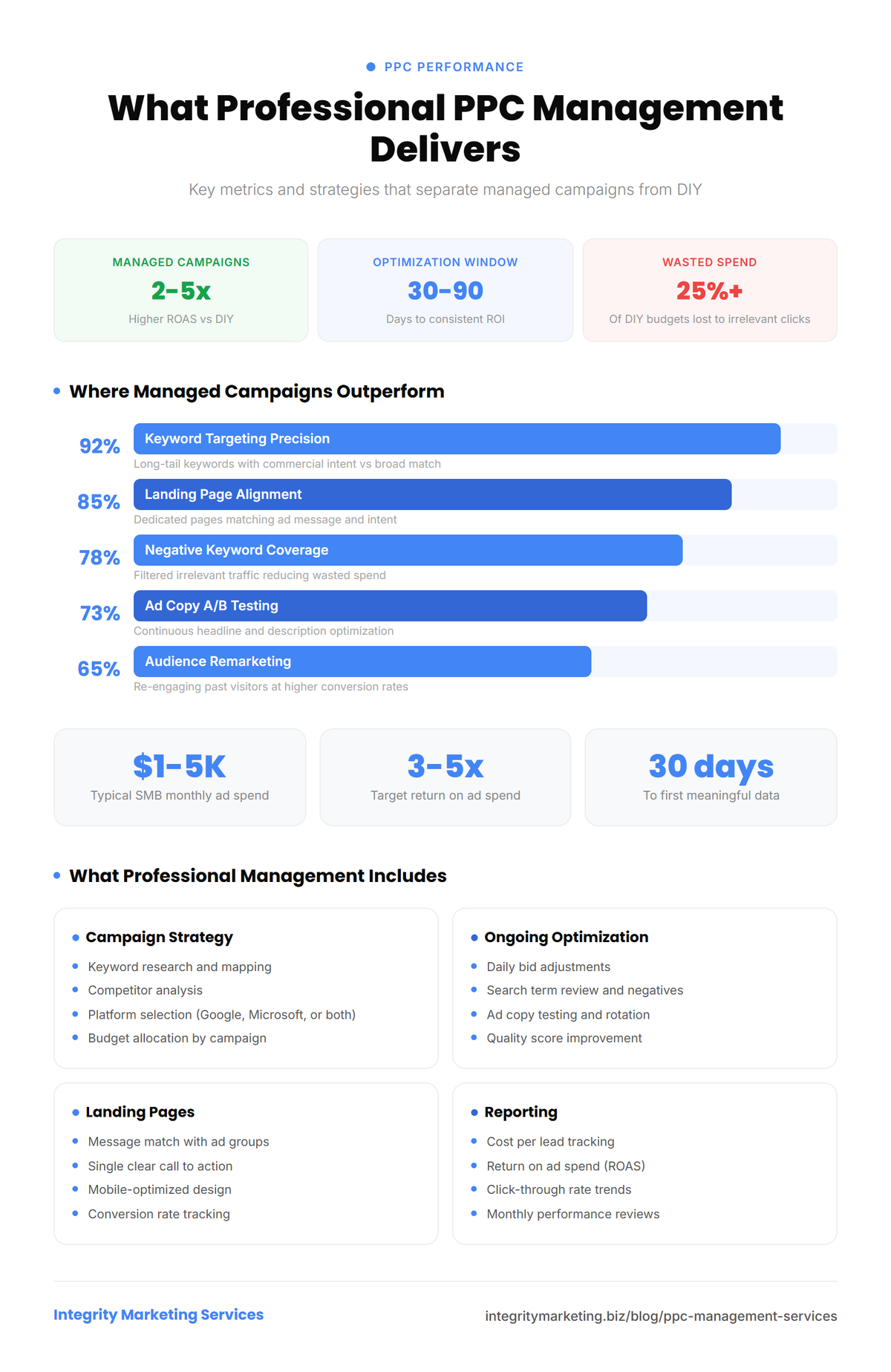
- Precise keyword targeting: Identifying the long-tail keywords that drive conversions while filtering out irrelevant search terms through negative keyword lists.
- Continuous ad testing: Writing and A/B testing multiple ad variations to find the message that resonates most with your audience.
- Bid management: Knowing when to use automated bidding versus manual bidding, and adjusting for device, location, and time of day.
Tracking and interpretation
The real power of PPC is in the data, but only if you set up tracking correctly and know how to act on what you see. Many businesses skip proper conversion tracking entirely, which means they are spending money with no clear picture of what is working. From there, constant analysis and adjustment is required to lower cost per lead and improve ROI over time.
How We Manage PPC Campaigns
At Integrity Marketing, we turn PPC from a line item on a budget into an engine that generates qualified leads. Our process is built on strategy, structure, and continuous improvement.
Strategic keyword research
We go beyond broad, expensive keywords to find the high-intent search queries that signal someone is ready to buy. Our focus is on lead-generating keywords that drive qualified traffic, not just volume. This means your budget goes toward clicks that are most likely to become customers.
Campaign structure and setup
A disorganized campaign wastes money. We build tight, well-segmented campaigns where every ad group targets a specific keyword theme. This structure improves quality scores, lowers your cost per click, and puts more relevant ads in front of the right people. We also advise on platform selection, determining whether Google Ads, Microsoft Ads, or a combination is the right fit.
Ad creation and testing
Your ad copy is your first impression. We write ads that speak directly to the user's problem and offer a clear solution. Then we test everything: headlines, descriptions, calls to action. The goal is continuous improvement, always pushing toward higher click-through rates and better conversion performance.
Ongoing Optimization Strategies
Launching a campaign is just the starting line. The real value of working with a PPC agency shows up in the ongoing optimization that turns a decent campaign into a high-performing one.
Data-driven adjustments
We monitor performance metrics daily: click-through rates, conversion rates, cost per acquisition, and return on ad spend. When something is working, we scale it. When something is not, we adjust before it drains budget. Every decision is backed by data, not gut feeling.
Landing page alignment
A click is wasted if the landing page does not deliver. We ensure your ads and landing pages match in message and intent. When a user finds exactly what they expected after clicking, they are far more likely to convert. Misaligned landing pages are one of the most common (and most expensive) mistakes we see in audits.
Audience targeting and remarketing
Reaching the right people matters as much as choosing the right keywords. We use audience segmentation to refine who sees your ads based on demographics, interests, and behavior. We also build remarketing campaigns to re-engage users who visited your site but did not convert. These returning visitors often convert at significantly higher rates.
What to Expect From a PPC Agency
Hiring an agency should feel like gaining a strategic partner, not just outsourcing a task. Here is what that partnership should look like:
- Transparent reporting: You deserve to know exactly how your budget is performing. We provide clear reports that track the metrics that matter: leads generated, cost per lead, and return on investment. No vanity metrics, no jargon.
- Continuous improvement: The digital landscape shifts constantly. Your campaigns need to adapt. We test and refine on an ongoing basis to stay ahead of market changes and keep performance trending upward.
- Strategic guidance: Beyond day-to-day management, we help you make informed decisions about budget allocation, platform selection, and how paid advertising fits into your broader marketing strategy.
Local Expertise Across the Puget Sound
Integrity Marketing is headquartered in Kirkland, Washington, right in the middle of one of the most competitive digital advertising markets in the country. We are not a faceless national firm. We are part of the local business community we serve.
Our PPC management supports businesses across the entire Puget Sound region, including King, Snohomish, and Pierce counties. We understand the competitive landscape here because we operate in it every day. The tech-heavy market, the high CPCs, the educated consumer base: these are factors we account for in every campaign we build.
That local knowledge matters. A business in Kirkland competing for clicks against enterprise companies in Bellevue and Seattle needs a different strategy than a business in a smaller market. We know the nuances because we live them.
Our PPC Management Services
We handle every aspect of paid advertising so you can focus on running your business:
- PPC strategy development: A custom plan aligned with your business goals, target audience, and budget.
- Campaign setup and optimization: Campaigns built from the ground up with best practices for structure, targeting, and ad copy.
- Ongoing campaign management: Daily monitoring, testing, and refinement to improve performance month over month.
- Performance reporting and analytics: Transparent reports that show you the real business impact of your advertising investment.
Frequently Asked Questions
How much should a small business budget for PPC?
Budgets vary by industry and competition, but many small businesses start with $1,000 to $5,000 per month in ad spend. The right budget depends on your keyword costs, target market, and how aggressively you want to generate leads. We help you find the right starting point and scale from there.
How long does it take for PPC campaigns to become profitable?
Most campaigns start generating traffic and leads quickly, but consistent ROI typically takes 30 to 90 days of testing and optimization. During that period, we refine targeting, ad performance, and conversion rates to find the winning combination for your business.
What metrics determine whether a PPC campaign is successful?
The metrics that matter most are cost per lead, conversion rate, click-through rate, and return on ad spend. These tell you whether your campaigns are generating profitable leads, not just clicks.
Do I need a separate landing page for PPC ads?
Yes. Dedicated landing pages consistently outperform homepages for paid traffic. A landing page aligned with the ad's message and built around a single call to action significantly improves conversion rates.
Can PPC campaigns be adjusted in real time?
That is one of PPC's biggest advantages. Campaigns can be adjusted immediately: modifying keywords, bids, targeting, or ad copy to improve results and reduce wasted spend. Unlike traditional advertising, you are never locked into something that is not working.
Stop wasting ad spend
Want to know if your Google Ads are working?
We audit over 100 accounts a year and find an average of 25% wasted spend. Get a free audit and see where your budget is really going.