

AI Content Optimization: Writing for Both Search Engines and People
Is it possible to create content that both Google’s algorithms and your human audience will love? In today’s digital landscape, where Artificial Intelligence is reshaping how we find information, this question is more critical than ever. Many businesses feel caught between keyword-stuffed articles for search engines and crafting engaging stories for people. The good news is, you don’t have to choose. The goals of search engines and readers are converging, and AI can be a powerful ally in satisfying both.
What Search Engines and Readers Actually Need
Before diving into strategy, let’s clarify what both audiences require from your content:
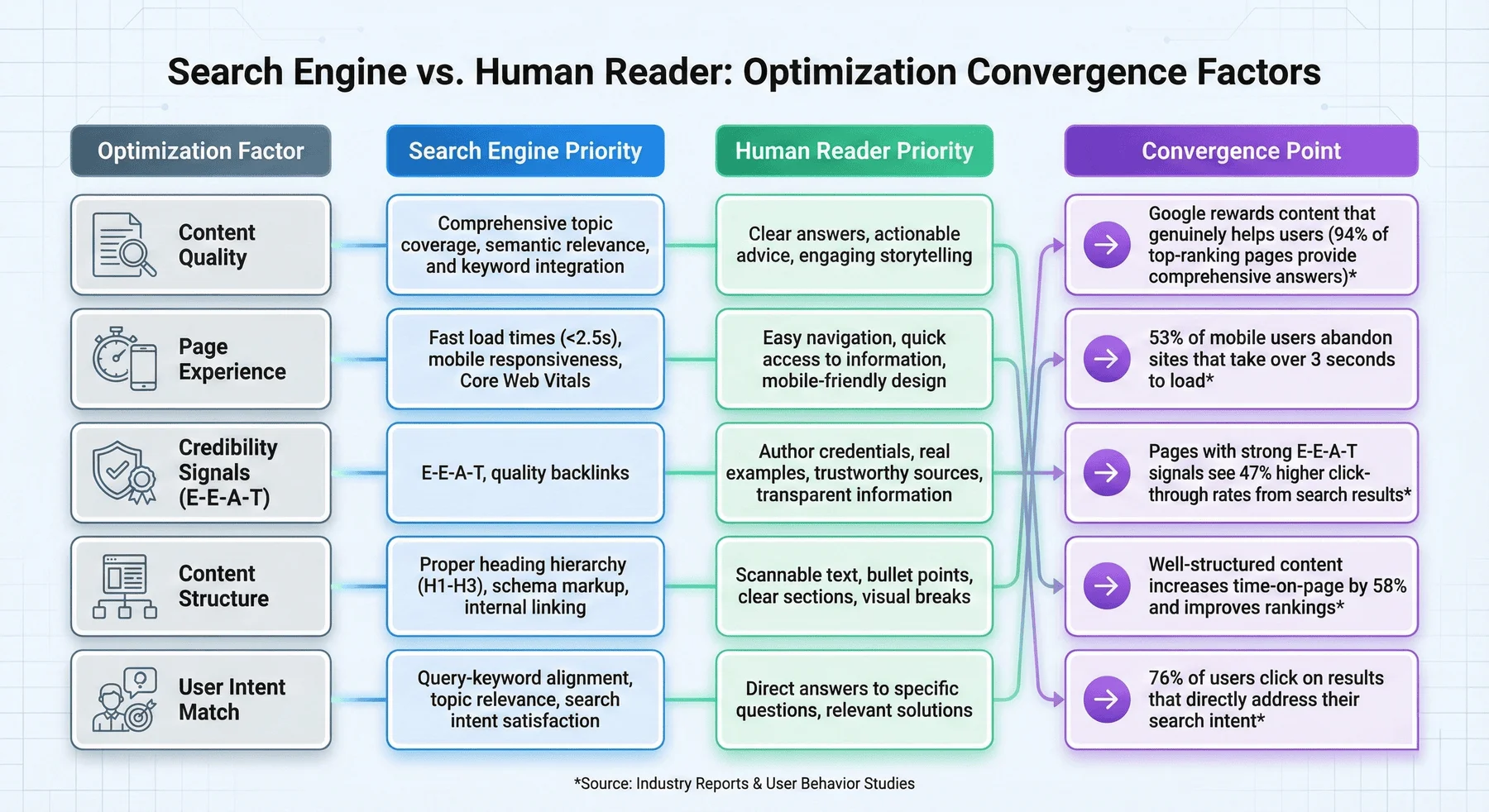
This table reveals a critical insight: search engines have evolved to measure the same signals that create positive human experiences. When you optimize for genuine user value, you’re simultaneously optimizing for search rankings.
This guide will explore how you can leverage AI content optimization to create articles that not only rank high on search engine results pages but also build trust and connect with your audience. We’ll dive into the current state of AI in search, provide a practical framework for creating balanced content, and show you how to make AI your most valuable content creation assistant.
The Two Masters: Understanding Search Engines and Human Readers
To create truly effective content, you first need to understand the two audiences you’re writing for. While their needs might seem different at first glance, they are becoming more aligned every day, especially with Google’s increasing focus on user experience.
What Search Engines Want
Think of a search engine like a librarian. Its primary job is to find the most helpful, relevant, and trustworthy answer to a user’s question. To do this, it looks for specific signals in your content:
- Keywords and Topics: Search engines scan for keywords to understand what your page is about. This includes primary keywords, related secondary terms, and a broad range of concepts that demonstrate topical authority.
- Structure and Readability: A well-organized article with clear headings (H1, H2, H3), short paragraphs, and lists is easier for algorithms to crawl and understand. This structure also signals a positive user experience.
- E-E-A-T (Experience, Expertise, Authoritativeness, Trustworthiness): Google prioritizes content that demonstrates real-world experience, deep expertise, and comes from a credible source. This is why content that is authentic and backed by evidence performs well.
- Helpful Content: Google’s core updates consistently favor “helpful, reliable, people-first content.” The algorithm is designed to reward content that genuinely solves a user’s problem rather than content created solely to rank.
What Human Readers Crave
While a search engine analyzes data, a human reader is looking for connections and solutions. They are driven by curiosity, pain points, and the need for clear answers. Here’s what captures their attention:
- Clarity and Engagement: People don’t want to read a textbook. They want content that is easy to digest, visually scannable, and written in a natural, conversational tone.
- Authentic Voice: Readers connect with a distinct brand voice. Whether it’s professional, witty, or compassionate, an authentic tone builds trust and makes your content memorable.
- Real-World Value: Your audience wants more than just facts; they want practical advice, actionable steps, and relatable examples or stories that bring your points to life.
- Answers to Their Questions: Ultimately, a reader landed on your page for a reason. Your content must directly address their query and provide a comprehensive, satisfying answer.
The key takeaway is that search engines are getting smarter at thinking like humans. Optimizing for one now often means optimizing for the other.
The Role of AI in Modern Content Strategy
Artificial intelligence has moved far beyond basic text generation. Today’s AI tools can assist with nearly every stage of the content creation process, from initial research to final optimization. However, using AI, particularly April AI, effectively requires understanding its strengths and weaknesses. The goal is not to replace human creativity but to augment it.
The Power and Pitfalls of AI Content
When used correctly, AI can be a massive productivity booster. It excels at tasks that are data-intensive and time-consuming.
Advantages of AI:
- Efficiency: AI can generate outlines, drafts, and meta descriptions in seconds, drastically cutting down production time.
- Idea Generation: Stuck for ideas? AI can brainstorm blog topics, headlines, and different angles for your content.
- Data Analysis: AI tools can quickly analyze competitor content, identify keyword gaps, and suggest topics that will give you a competitive edge.
Disadvantages of AI:
- Generic Output: Without specific guidance, AI-generated content can be bland, repetitive, and lack a distinct brand voice.
- Factual Inaccuracies: AI models can sometimes produce incorrect or outdated information, a phenomenon known as “hallucination.” Fact-checking is non-negotiable.
- Lack of True Experience: AI cannot replicate genuine human experience, emotion, or unique insights. This is a critical component of Google’s E-E-A-T guidelines.
The most effective approach is a hybrid model where AI handles the heavy lifting of research and drafting, while human experts provide the strategy, refinement, and authentic voice.
Where April AI Fits Into Modern Content Creation
While generic AI tools help with brainstorming, drafting, and research, they fall short in one critical area: strategic alignment. Most AI models don’t understand your brand voice, your customer psychology, or your broader SEO goals. They produce content, but not content that performs.
This is where April AI, our proprietary content optimization engine, changes the game.
April AI was built specifically for businesses that need content to do more than fill space. It functions as a coordinated team of specialized AI agents, each trained to perform a specific role in the content pipeline:
- A Requirements Extractor that studies your target audience, intent, and keyword landscape
- An SEO Strategist who develops a ranking-focused plan
- A Content Manager who ensures clarity, flow, and human readability
- A Copywriter who writes in your brand voice with natural language
- A Web Packager that formats everything for publishing and on-page SEO
While other AI tools generate text, April AI generates strategically aligned, search-ready content that is engineered to satisfy both humans and algorithms.
Most importantly, April AI works in partnership with human experts, not as a replacement for them. Your insights, experience, and final judgment remain the core of the process. April AI simply accelerates the heavy lifting, ensures consistency, and produces content that is far more likely to rank, convert, and maintain quality over time.
A Practical Framework for AI-Powered Content Optimization
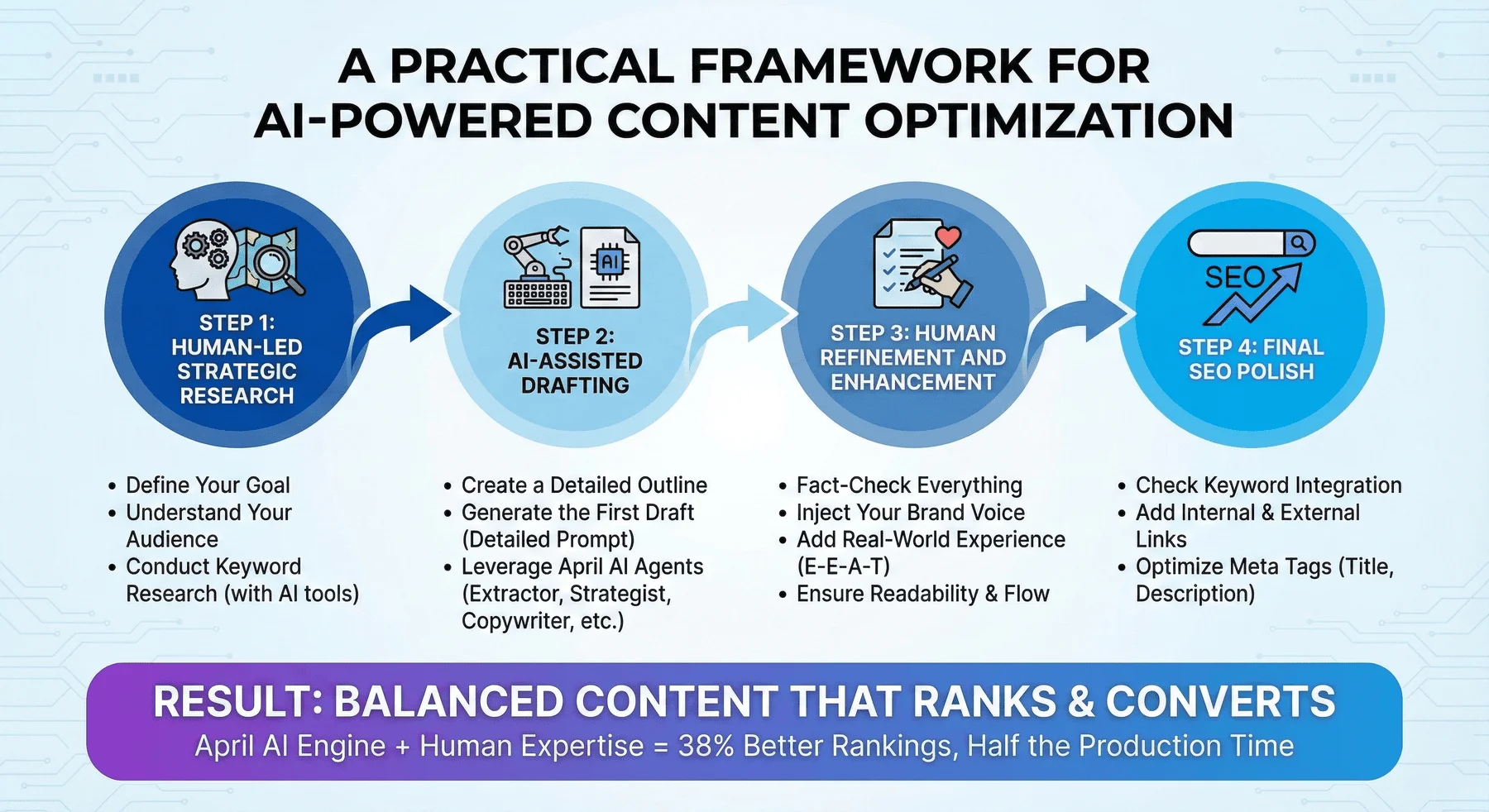
So, how do you put this hybrid approach into practice? Follow this four-step framework to create content that is optimized for search engines and genuinely valuable for your readers.
Step 1: Human-Led Strategic Research
Before you write a single word, you need a solid plan. Your strategy should always be guided by human insight, even if you use AI tools to gather data.
- Define Your Goal: What do you want this piece of content to achieve? Is it to attract new leads, educate existing customers, or build authority on a specific topic?
- Understand Your Audience: Who are you writing for? What are their pain points and questions?
- Conduct Keyword Research: Use AI-powered tools like SEMrush or Ahrefs to identify target keywords, but use your human expertise to select the ones that best match user intent.
Step 2: AI-Assisted Drafting
Once you have your strategy, use AI as your personal writing assistant to speed up the drafting process.
- Create a Detailed Outline: Feed your keyword research and topic goals to an AI tool and ask it to generate a comprehensive outline with H2 and H3 headings.
- Generate the First Draft: Provide the AI with a detailed prompt. Include your target keywords, desired tone of voice, target audience, and any specific points you want to cover. The more detailed your prompt, the better the output.
Step 3: Human Refinement and Enhancement
This is where you transform a generic AI draft into a valuable piece of content. Your human touch is what adds the critical elements of E-E-A-T.
- Fact-Check Everything: Verify all stats, facts, and claims made by the AI.
- Inject Your Brand Voice: Rewrite sentences to reflect your company’s unique personality and style.
- Add Real-World Experience: Weave in personal anecdotes, case studies, or specific examples from your industry. This is something only a human expert can do.
- Ensure Readability: Read the article aloud to check for flow and a natural, conversational rhythm. Break up long paragraphs and simplify complex sentences.
Step 4: Final SEO Polish
With the core content in place, circle back to ensure it’s technically optimized for search engines.
- Check Keyword Integration: Make sure your target keywords are included naturally in the title, headings, and body text.
- Add Internal and External Links: Link to other relevant pages on your site to build a strong internal linking structure. Link out to authoritative external sources to support your claims.
- Optimize Meta Tags: Write a compelling, keyword-rich meta title and meta description to encourage clicks from search results.
This strategic, human-guided process is the foundation of our proprietary April AI SEO engine. It was built on research and a real strategy to deliver content that achieves stronger rankings while aligning perfectly with your brand’s voice and goals. By combining specialized AI agents, including a Requirements Extractor, SEO Specialist, Content Manager, Copywriter, and Web Page Packager, with expert human oversight, April AI produces content that performs 38 percent better in rankings while cutting production time in half. It’s the embodiment of writing for both search engines and people.
Conclusion
The rise of AI doesn’t spell the end of human creativity; it marks the beginning of a new partnership. Creating content that ranks well and resonates with people is no longer about choosing one over the other. It’s about finding the perfect balance. By using AI as a powerful assistant for research and drafting, you can free up your human experts to focus on what they do best: providing strategy, sharing unique insights, and building authentic connections with your audience. This hybrid approach is the key to winning in the modern world of search.
Take Your Content to the Next Level
If you’re looking to harness the power of AI for your content strategy without sacrificing the quality and authenticity that builds trust, our team is here to help. Contact us today to learn how our proven processes and the April AI engine can deliver measurable results for your business.

About the author