


The Ultimate Guide to Choosing Marketing Channels for Your Small Business
Are you a business owner staring at a dozen different marketing “opportunities,” feeling completely overwhelmed? One expert tells you to go all-in on TikTok, another swears by Google Ads, and a third insists that old-school print is making a comeback. With a limited budget and even more limited time, the pressure to make the right choice is immense. Where do you even begin? How do you cut through the noise and find the channels that will actually generate leads and grow your business, not just drain your bank account?
This isn’t another short list of generic tips. This is a comprehensive, deep-dive guide designed to give you a complete framework for making strategic marketing decisions. We’re going to walk through everything from understanding your core business goals to analyzing the nitty-gritty details of each marketing channel, both digital and traditional. By the end of this guide, you will have a clear, actionable plan to build a marketing strategy that delivers real, measurable results for your small business.
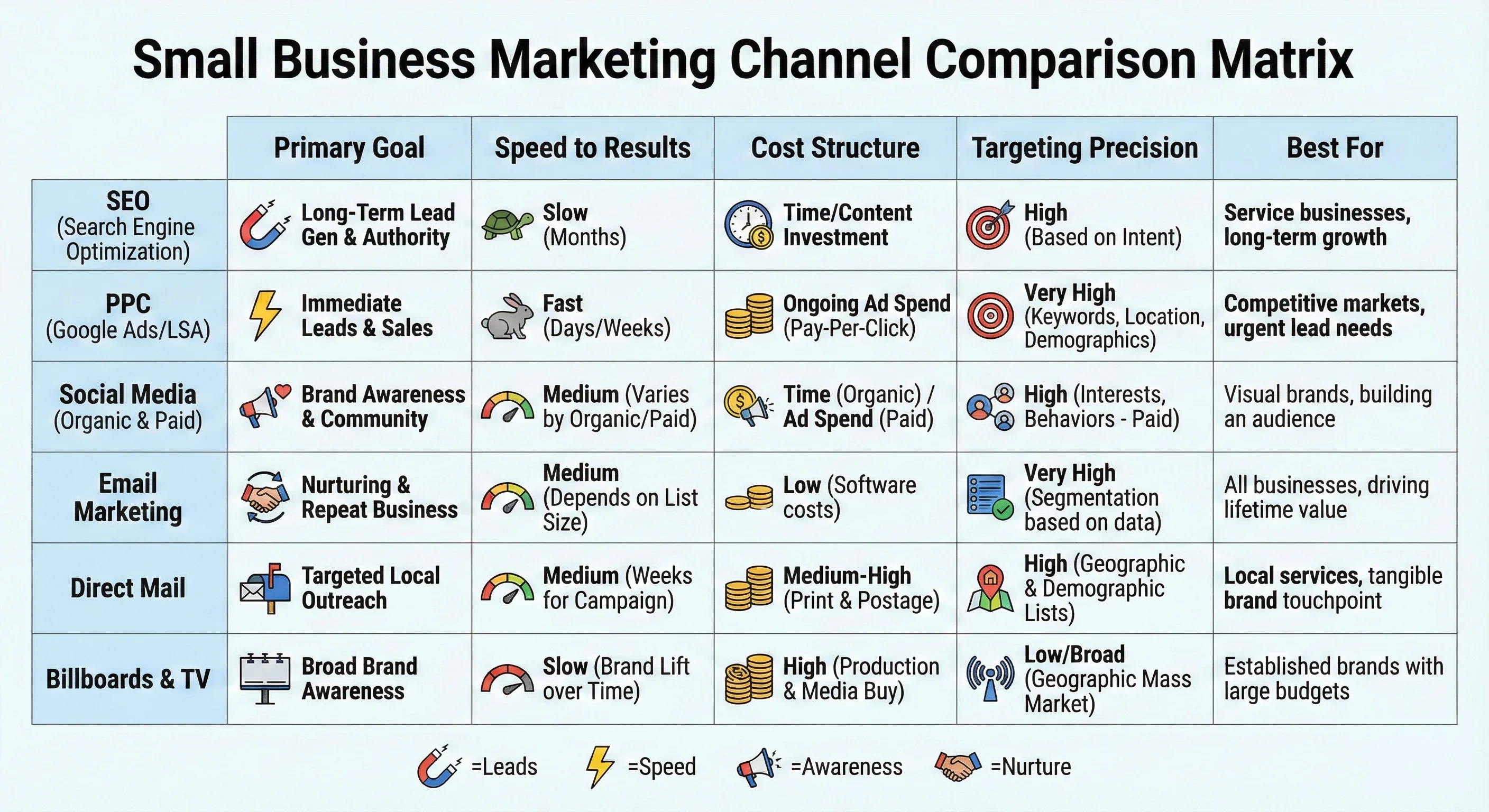
The Foundational Framework: What to Do Before You Spend a Single Dollar
Before selecting channels, you need to establish a solid foundation. Skipping this step is like building a house without a blueprint; it’s a recipe for disaster. Investing a few hours here will save you thousands of dollars and countless headaches down the road.
Step 1: Define Your Core Business Objectives
What do you really want your marketing to accomplish? “More business” is not a specific enough answer. Your marketing objectives must be SMART: Specific, Measurable, Achievable, Relevant, and Time-bound.
Increase Brand Awareness:
Is your business new or entering a new market? The primary goal might be to let people in your target area know you exist. This is about getting your name, logo, and message in front of as many relevant people as possible.
Example Goal: Increase brand recognition within the Bellevue remodeling market by 20% over the next 12 months.
Generate High-Quality Leads:
This is a common goal for service-based businesses like contractors, therapists, and lawyers. The focus isn’t just on getting any lead; it’s about attracting potential clients who are a perfect fit for your services and ready to invest.
Example Goal: Generate 15 qualified leads per month for high-end kitchen remodels through our website.
Drive Direct Sales or Bookings:
For e-commerce businesses or services that allow online booking (like therapists), the goal is a direct transaction. Marketing efforts are geared towards moving a customer to a point of purchase as quickly as possible.
Example Goal: Achieve a 10% increase in online product sales in Q3.
Establish Industry Authority:
Do you want to be seen as the go-to expert in your field? This objective focuses on building trust and credibility through educational and informative content. For a luxury remodeler, this could mean becoming the trusted source for renovation advice in the Pacific Northwest.
Example Goal: Become one of the top 3 most-referenced resources for “basement finishing ideas” in our local market by publishing one in-depth blog post per week.
Your primary objective will heavily influence which channels you prioritize. Lead generation often points toward search-based channels, while brand awareness might favor social media, display advertising, or even traditional channels like billboards.
Step 2: Create a Hyper-Detailed Customer Persona
You cannot effectively market to someone you don’t understand. A customer persona is a semi-fictional representation of your ideal client based on market research and real data about your existing customers.
Go beyond basic demographics. Think about their daily life, their struggles, and what motivates them. For a high-end remodeler in Kirkland, a persona might look like this:
- Name: “Rachel Redmond”
- Demographics: Age 45-60, household income $250k+, lives in a single-family home in a desirable Seattle suburb like Issaquah or Sammamish.
- Pain Points: Her kitchen is outdated and feels cramped when entertaining guests. She feels embarrassed by it. She’s overwhelmed by the thought of a messy, prolonged renovation. She doesn’t know which contractors are trustworthy and fears being overcharged for subpar work.
- Goals: She wants a beautiful, functional, “spa-like” kitchen that becomes the centerpiece of her home. She wants a smooth, predictable process with a contractor who communicates clearly and respects her home.
- Watering Holes: Where does she spend her time online? Probably browsing Pinterest and Houzz for inspiration, reading local lifestyle magazines, and searching on Google for “best kitchen remodelers Bellevue.” She’s active in local Facebook groups for her community.
Creating this level of detail allows you to answer the most important question: Where is my ideal customer’s attention? Your marketing channels should be the bridges that connect your business to these “watering holes.”
Step 3: Set a Realistic and Strategic Marketing Budget
Marketing is an investment, not an expense. But how much should you invest? There are several models for setting a budget:
- Percentage of Revenue: A common rule of thumb is to allocate 5-10% of your total revenue to marketing. New businesses or those in a high-growth phase might push this to 12-15%.
- Objective-Based: This is a more strategic approach. Determine your goal (e.g., “I need 20 new roofing leads per month”). Research the average cost-per-lead (CPL) in your industry and location for different channels. Then, build your budget backward from there. For example, if the average CPL from Google Ads is $100, you’d need a budget of at least $2,000/month for that channel alone.
- Competitor-Based: Look at what your competitors are doing. While you can’t know their exact budget, tools like SEMrush, AHrefs, or SpyFu can estimate their spending on Google Ads. This can give you a baseline for what it takes to compete in your market.
Remember to factor in not just ad spend but also the costs of management, content creation, and tools.
The Digital Marketing Arsenal: A Deep Dive into Your Channel Options
With your foundation in place, it’s time to explore the tools in your arsenal. We’ll break down the most powerful digital marketing channels, their pros and cons, and who they’re best for.
Your Website Is the Hub – The Digital Foundation You Own
Your website is not just another channel; it is the central hub of your entire digital presence. It is the only digital asset you truly own and control. All other channels, from Google to Facebook, should ultimately be driving traffic back to your website, where you can convert visitors into leads and customers. Think of your website as a digital storefront. The URL is your address. The goal is to convert people to this digital storefront and encourage traffic for leads and sales.
A professionally designed, user-friendly website is non-negotiable. For businesses like contractors, retailers, therapists, and consultants, your website must build trust instantly. This means:
- Modern, Mobile-First Design: Over half of all web traffic is on mobile. If your site is difficult to navigate on a phone, you’re losing customers.
- Fast Load Times: A site that takes more than 3 seconds to load will see a massive drop-off in visitors. Page speed is a critical factor for both user experience and SEO.
- Clear Calls-to-Action (CTAs): Make it incredibly easy for visitors to take the next step. “Request a Consultation,” “Call Us Today,” and “Download Our Guide” should be prominent and easy to find.
- High-Quality Photography and Videography: For remodelers, painters, and roofers, showcasing your work with professional photos and before-and-after galleries is essential. Consider services like Matterport 3D tours to let clients virtually walk through your completed projects.
- Trust Signals: Display your licenses, insurance, certifications, and customer reviews prominently to build credibility.
Who it’s for: Every single business, without exception.
Bottom Line: Before you invest in driving traffic, ensure you have a high-performance destination to send it to. A custom website provides the flexibility and scalability that organizations need.
Channel 1: Search Engine Optimization (SEO) – The Long-Term Growth Engine
Search Engine Optimization is the process of improving your website to increase its visibility when people search for products or services related to your business in search engines like Google. Think of it as earning your way to the top of the search results, rather than paying for an ad.
SEO is a long-term strategy, but it often delivers the highest return on investment over time. When someone searches for “luxury bathroom renovations Seattle,” they have a very high intent to buy. Appearing as the top organic result for that search is incredibly valuable.
SEO is a complex discipline with several key components:
On-Page SEO:
This involves optimizing the content and structure of your actual web pages. This includes strategic keyword placement, writing compelling meta titles and descriptions, using proper headings (H1, H2, H3), and ensuring your content thoroughly answers the user’s query.
Technical SEO:
This is the behind-the-scenes work that helps search engines crawl and index your site more effectively. It includes things like improving page speed, creating an XML sitemap, using SSL for security, and fixing broken links.
Content Marketing:
This is the fuel for your SEO engine. Creating high-quality, valuable content like blog posts, service pages, and location-specific pages gives Google more reasons to rank your site. A remodeler might write blog posts on “How to Budget for a Kitchen Remodel” or “Top Design Trends for 2024.” This establishes expertise and attracts users at the top of the sales funnel. Advanced agencies may even use proprietary AI engines to research and develop content strategies that deliver stronger rankings more efficiently.
Local SEO:
For any business serving a specific geographic area (like most contractors, therapists, and lawyers), Local SEO is critical. This involves optimizing your Google Business Profile, building local citations (mentions of your business on other local websites), and gathering customer reviews. The goal is to appear in the “Map Pack” – the box with three local business listings that appears at the top of many local searches.
Who it’s for: Businesses with a long-term growth mindset, especially service-based businesses that rely on high-intent local searches. On top of this, SEO is a needed aspect of any business that sells a product or service. Bottom Line: SEO is not a quick fix, but it is the most sustainable way to generate a predictable pipeline of high-quality leads. It’s an investment in your business’s future visibility.
Channel 2: Pay-Per-Click (PPC) Advertising – For Immediate and Targeted Results
PPC, with Google Ads being the dominant platform, allows you to place ads at the top of the search results page. Unlike SEO, which takes time, a Google Ads campaign can start driving traffic to your site. You bid on keywords, and you only pay when someone clicks on your ad.
This channel is powerful because you can target users with extreme precision based on the keywords they search, their location, demographic information, the time of day, and more. For a contractor, this means you can show an ad specifically to someone in Bellevue who searches for “basement finishing contractor” on a Saturday morning.
The main types of Google Ads campaigns include:
- Search Ads (Text Ads): These are the text-based ads that appear at the top of Google search results. They are perfect for capturing high-intent users actively looking for a solution.
- Display Ads: These are visual banner ads that appear on other websites across the Google Display Network. They are better for brand awareness than for direct lead generation.
- Local Service Ads (LSAs): For eligible service businesses (like plumbers, electricians, and roofers), LSAs are a game-changer. These ads appear above even the traditional PPC ads and feature a “Google Guaranteed” badge, which builds immense trust. You pay per lead, not per click.
- Remarketing Ads: These ads are shown to people who have previously visited your website but didn’t convert. It’s a powerful way to stay top-of-mind and bring interested prospects back to your site.
- Performance Max (PMax): Google’s all-in-one campaign type that uses AI to show ads across Search, YouTube, Maps, Gmail, and the Display Network. It’s ideal for businesses looking to maximize reach and conversions by leveraging Google’s AI functionality.
Who it’s for: Businesses that need leads now, businesses in competitive markets, and those who want highly measurable and scalable campaigns. It works exceptionally well when paired with a strong SEO strategy. Bottom Line: Google Ads offers unparalleled control and speed. While it requires an ongoing budget and optimization work, the ability to generate immediate, high-intent leads makes it an essential channel for many small businesses, especially those in the trades. Working with a certified Google Partner agency ensures your campaigns are managed by experts.
Channel 3: Social Media Marketing – For Building Community and Brand Personality
Social media is not just for sharing vacation photos. Platforms like Facebook, Instagram, and LinkedIn are powerful tools for businesses to connect with their audience, build a brand personality, and nurture potential customers.
The key to social media is choosing the right platform and creating content that provides value, rather than just selling.
Facebook:
With its massive user base, Facebook is versatile. It’s great for local businesses to build a community page, share updates, run targeted ads, and engage with customers.
Instagram:
A highly visual platform, Instagram is perfect for businesses that can showcase their work through compelling imagery. Remodelers, painters, and designers can build a strong following by posting high-quality photos and videos of their projects.
LinkedIn:
This is the go-to platform for B2B (business-to-business) marketing and for professionals like lawyers and consultants. It’s ideal for sharing industry insights, networking, and establishing professional credibility.
Pinterest:
For home service industries, these visual discovery platforms are essential. Homeowners actively use them to find inspiration and professionals for their renovation projects. Having a strong profile here is a must for any remodeler or designer.
TikTok:
A rapidly growing platform for short-form video content, TikTok is excellent for businesses that can demonstrate their expertise, showcase before-and-after transformations, or share quick tips engagingly and authentically. Its algorithm favors creative content and can help businesses reach new audiences organically.
There are two sides to social media marketing:
Organic Social:
This involves building your profile, posting regular content, and engaging with your followers without paying for promotion. It’s great for building a loyal community, but it can be slow to grow.
Paid Social:
This involves running targeted ad campaigns on platforms like Facebook and Instagram. The targeting capabilities are incredible; you can target users based on their demographics, interests, behaviors, and even life events.
Who it’s for: Almost all businesses can benefit, but it’s especially powerful for visual brands (remodelers, e-commerce) and those looking to build a strong community and brand personality.
Bottom Line: Don’t try to be on every platform. Pick one or two where your ideal customer spends their time and focus on creating valuable, engaging content consistently.
Channel 4: Email Marketing – For Nurturing Leads and Driving Repeat Business
Email marketing consistently delivers one of the highest ROIs of any marketing channel. Why? Because you are communicating with an audience that has already permitted you to contact them. It’s the perfect channel for building relationships and moving leads through the sales funnel.
Effective email marketing is not about spamming your list. It’s about segmentation and providing value.
- Building Your List: Offer something of value in exchange for an email address. This could be a downloadable guide (“The Homeowner’s Guide to Hiring a Contractor”), a discount code, or a newsletter with helpful tips.
- Nurture Sequences: When someone new joins your list, send them an automated series of emails that introduces your brand, provides helpful information, and gently guides them toward becoming a customer.
- Newsletters: Send out a regular newsletter with project highlights, company news, and educational content to stay top-of-mind with past clients and current leads.
- Promotional Emails: Use email to announce special offers or seasonal promotions.
Who it’s for: Every business. It’s particularly vital for e-commerce, which has a crucial sales cycle, and any business with a longer sales cycle (like high-end remodeling), where nurturing a lead over time is critical
Bottom Line: Your email list is a valuable asset. Focus on growing it and providing your subscribers with content that helps them, and it will pay dividends for years to come.
Traditional Marketing Channels: When Offline Tactics Make Sense
While digital marketing dominates modern strategy, traditional marketing channels still have their place, particularly for local businesses targeting specific geographic markets. The key is understanding when these channels make sense for your business and how to measure their effectiveness.
Channel 5: Direct Mail – Targeted Physical Outreach
Direct mail involves sending physical marketing materials, postcards, letters, brochures, or catalogs directly to potential customers’ mailboxes. While it may seem outdated in our digital age, direct mail can be surprisingly effective when executed strategically.
The power of direct mail lies in its tangibility and ability to cut through digital noise. In an era where the average person receives hundreds of emails daily, a well-designed postcard can stand out. For local service businesses like remodelers or roofers, direct mail allows you to target specific neighborhoods where you’ve recently completed projects or where demographic data suggests high-value prospects live.
Key Strategies for Effective Direct Mail:
- Hyper-Targeted Lists: Don’t waste money on broad, generic mailing lists. Use demographic data to target homeowners in specific zip codes with household incomes that match your ideal customer profile. For a luxury remodeler, this might mean targeting homes valued at $750k+ in Bellevue or Redmond.
- Compelling Design: Your mailer has about 3 seconds to capture attention. Use high-quality images of your best work, clear headlines, and a single, strong call-to-action.
- Trackable Offers: Include a unique phone number, QR code, or promotional code so you can measure response rates and ROI accurately.
- Multi-Touch Campaigns: One mailer is rarely enough. Plan a series of 3-5 mailings to the same list over several months to build recognition and trust.
- Integration with Digital: Drive recipients to a dedicated landing page on your website where they can learn more and convert. This bridges the gap between offline and online marketing.
Cost Considerations: Direct mail can range from $0.50 to $3.00 per piece, depending on size, quality, and postage. For a campaign targeting 5,000 homes, expect to invest $2,500-$15,000. The key is calculating your acceptable cost-per-lead and ensuring your average project value justifies the investment.
Who it’s for: Any business with premium offerings, geographic or niche targeting, or strong visual content to share, from contractors and consultants to retailers and creative professionals.
Bottom Line: Direct mail works best as part of an integrated strategy, not as a standalone channel. It’s particularly effective for reinforcing your brand after someone has seen your digital ads or for re-engaging past customers with seasonal promotions.
Channel 6: Billboards – High-Visibility Brand Building
Billboard advertising involves placing large-format advertisements in high-traffic locations along highways, major roads, or in urban centers. The goal is to build brand awareness and create top-of-mind recognition through repeated exposure.
Billboards are not a direct-response channel. You won’t see immediate leads or sales from a billboard campaign. Instead, they work by creating familiarity. When someone in Seattle drives past your billboard advertising “Seattle’s Premier Kitchen Remodeler” every day on their commute for six months, your brand becomes the first one they think of when they’re ready to renovate.
Key Strategies for Effective Billboard Advertising:
- Location, Location, Location: The value of a billboard is entirely dependent on its location and traffic count. A billboard on I-5 near downtown Seattle will cost significantly more than one on a rural highway, but it will also reach far more of your target audience.
- Keep It Simple: Drivers have only 5-7 seconds to read your billboard. Use large, bold text (no more than 7-10 words), high-contrast colors, and a single, memorable message. Your phone number or website should be easy to read at 60 mph.
- Strong Visual Identity: Use your logo prominently and maintain consistent branding with your other marketing materials. The goal is instant recognition.
- Strategic Timing: Consider seasonal factors. A roofing company might run billboard ads in late fall when homeowners are thinking about winter weather damage.
- Geographic Targeting: Place billboards in areas where your ideal customers live, work, or commute. For a Bellevue-based remodeler, billboards along SR-520 or I-405 near affluent suburbs make strategic sense.
Cost Considerations: Billboard costs vary dramatically based on location, size, and market. In the Seattle area, expect to pay anywhere from $1,500 to $10,000+ per month for a single billboard in a prime location. Digital billboards, which allow you to rotate messages and share space with other advertisers, can be more affordable and flexible.
Measuring ROI: Billboards are notoriously difficult to track. Consider using unique phone numbers, vanity URLs, or asking new leads, “How did you hear about us?” during intake. Expect billboard advertising to contribute to overall brand lift rather than direct conversions.
Who it’s for: Established businesses with strong brand identities, companies serving broad geographic markets, businesses with significant marketing budgets ($3,000+/month for billboards alone), and those focused on long-term brand building rather than immediate lead generation.
Bottom Line: Billboards are a supporting player in your marketing mix, not the star. They work best for businesses that have already established a strong digital presence and want to amplify their local brand recognition. For most small businesses, digital channels will deliver better ROI.
Channel 7: Television Advertising – Mass Market Reach with Premium Costs
Television advertising involves creating video commercials that air on local broadcast stations, cable networks, or streaming platforms. TV ads can reach large audiences and build credibility through the prestige associated with television advertising.
The landscape of TV advertising has changed dramatically with the rise of streaming services. Traditional broadcast and cable TV still reach significant audiences, particularly older demographics, while Connected TV (CTV) and Over-The-Top (OTT) platforms like Hulu and YouTube TV offer more targeted, digital-like capabilities.
Key Strategies for Effective TV Advertising:
- Know Your Audience’s Viewing Habits: Different channels and time slots attract different demographics. Local news broadcasts might reach homeowners aged 50+, while streaming platforms skew younger. Match your media buy to your customer persona.
- Professional Production Quality: A poorly produced TV commercial can damage your brand more than help it. Budget for professional video production, including scripting, filming, editing, and talent if needed. Expect production costs of $5,000-$25,000 for a quality 30-second spot.
- Frequency Over Reach: It’s better to run your ad frequently on one or two channels than to spread your budget thin across many channels with low frequency. Viewers need to see your ad multiple times before it registers.
- Clear, Compelling Call-to-Action: Make it obvious what you want viewers to do next. “Visit SeattleRemodeler.com” or “Call 206-555-1234 for a Free Consultation” should be prominently displayed and spoken.
- Consider Local Cable or CTV: National broadcast TV is prohibitively expensive for most small businesses. Local cable advertising or targeted CTV campaigns can be more affordable while still reaching your geographic market.
Cost Considerations: TV advertising costs include both production and media buying (airtime). In the Seattle market:
- Production: $5,000-$25,000 for a professional 30-second commercial
- Local Cable Airtime: $200-$1,500 per spot, depending on the channel and time slot
- Broadcast TV Airtime: $1,000-$10,000+ per spot for local broadcast stations
- CTV/OTT: Often sold on a CPM (cost per thousand impressions) basis, ranging from $20-$40 CPM
A modest local TV campaign might require a budget of $10,000-$25,000 per month, including production and airtime.
Measuring ROI: Like billboards, TV advertising is challenging to track precisely. Use unique phone numbers, dedicated landing pages, and customer surveys. Consider TV as a brand-building investment that supports your other marketing efforts rather than a direct lead generation channel.
Who it’s for: Established businesses with substantial marketing budgets ($15,000+/month), companies targeting broad local markets, businesses where brand prestige and credibility are critical (luxury services, legal, medical), and those with products or services that benefit from visual demonstration.
Bottom Line: For most small businesses, TV advertising is a premium option that makes sense only after you’ve maximized digital channels and have a proven marketing system. The exception might be highly targeted CTV campaigns, which offer more affordability and measurability than traditional broadcast TV.
When to Use Traditional vs. Digital Channels
The question isn’t whether traditional marketing is “dead,” it’s whether it makes strategic sense for your specific business. Here’s a quick decision framework:
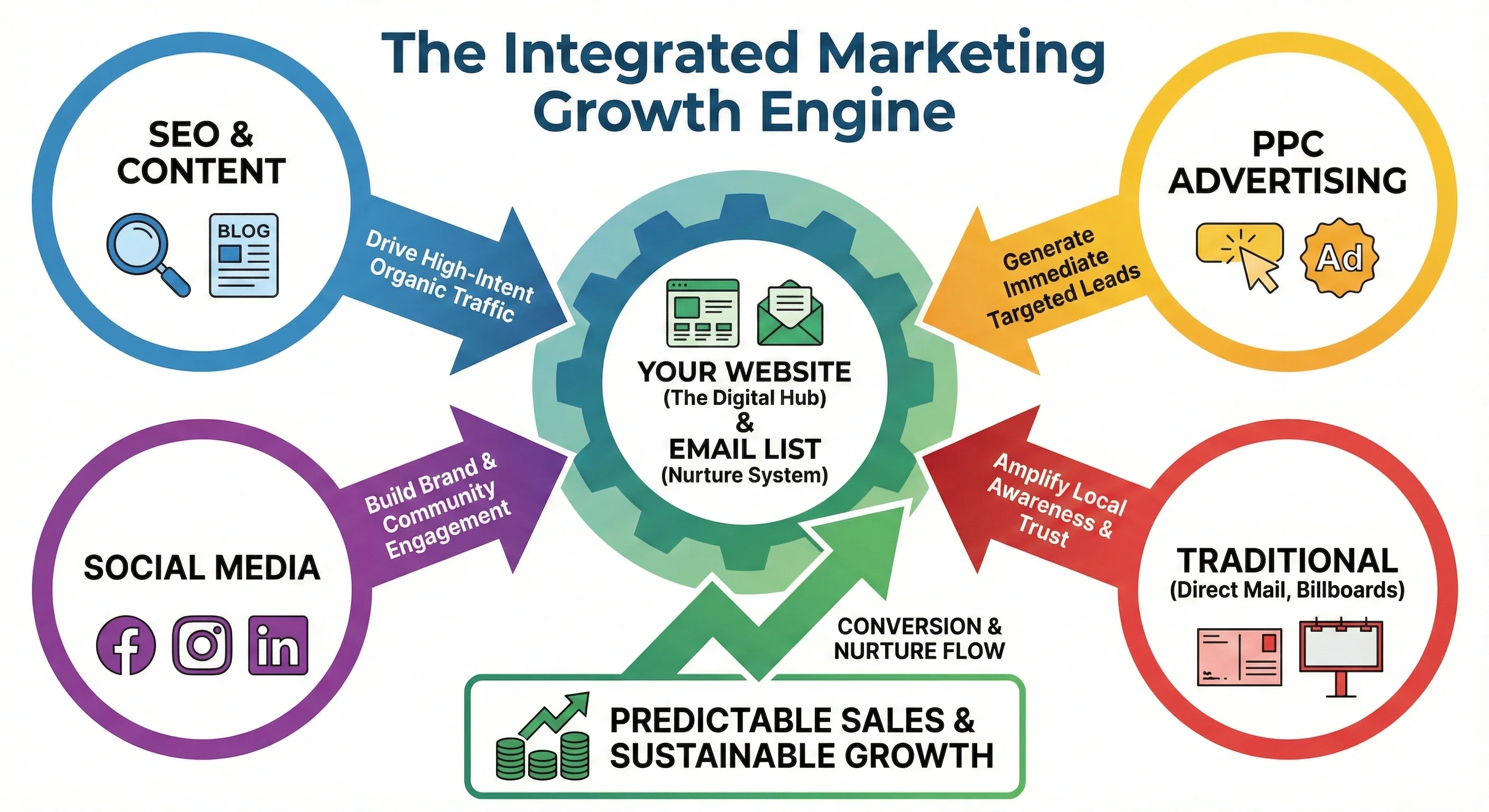
The Hybrid Approach: The most sophisticated marketing strategies integrate both. For example, a luxury remodeler might run billboards to build brand recognition, use direct mail to target specific neighborhoods, and then capture the resulting search traffic and website visits through SEO and Google Ads. Each channel reinforces the others, creating a comprehensive market presence.
Putting It All Together: Creating Your Integrated Marketing Mix
The most successful marketing strategies don’t rely on a single channel. They create an integrated system where each channel supports the others.
Consider this example for a Seattle-based roofing company:
- SEO & Content: They create a detailed blog post titled “Signs You Need a New Roof in the Pacific Northwest.” This article ranks on Google for related searches, attracting homeowners in the research phase.
- Website & Email: The blog post has a CTA to download a “Roofing Maintenance Checklist,” which requires an email address. The user is now on their email list.
- Email Marketing: The user receives an automated email nurture sequence. The first email delivers the checklist, followed by emails showcasing past projects, customer testimonials, and an offer for a free roof inspection.
- PPC & Remarketing: The company runs a Google Ads campaign targeting high-intent keywords like “roofer near me” and “roof replacement Seattle.” They also run a remarketing campaign on Facebook, showing ads to people who visited the blog post but didn’t download the checklist, reminding them of the company’s expertise.
- Direct Mail: The company sends targeted postcards to neighborhoods where they recently completed projects, showcasing the before-and-after photos and offering a “Neighbor Discount.”
- Billboard: A billboard on I-5 reinforces their brand as “Seattle’s Most Trusted Roofer,” creating familiarity for all the homeowners who will later search for them online.
In this system, every channel plays a role in moving the customer along their journey, from initial awareness to becoming a paying client.
Conclusion: Stop Guessing, Start Strategizing
Choosing the right marketing channels is one of the most critical decisions a small business owner can make. The temptation to chase the latest trend or copy a competitor is strong, but a strategic, foundational approach will always win in the long run.
Start by looking inward: define your goals, understand your ideal customer, and set a realistic budget. Then, evaluate each potential channel, both digital and traditional, not just on its own merits, but on how it fits into your overall system. A well-designed website is your foundation. SEO is your long-term asset for organic growth. PPC is your tool for immediate, targeted leads. Social media is your platform for building a brand personality, and email is your engine for nurturing relationships. Traditional channels like direct mail, billboards, and TV can amplify your reach when used strategically as part of an integrated approach.
This process isn’t about finding one “magic bullet.” It’s about building a robust, integrated marketing machine that works for your specific business, generating a predictable stream of leads and fueling sustainable growth for years to come.
Ready to Build Your Growth Engine?
Navigating the world of digital marketing can be complex, but you don’t have to do it alone. If you’re a business owner who is ready to move from guesswork to a data-driven strategy, our team is here to help. We specialize in creating integrated marketing systems that deliver measurable results. Contact us today for a free, no-obligation consultation to discuss your business goals.

About the author