


Why Audit Your Google Ads Account
Most Google Ads accounts waste 20-40% of their budget on fixable issues. A systematic audit finds those issues before they drain your budget for another month.
We have audited over 100 accounts since 2018. This is the same checklist we use internally. It covers 12 areas with specific pass/fail criteria you can check yourself.
"The top three issues I find in almost every audit: no negative keyword strategy (78% of accounts), conversion tracking that is broken or incomplete (65% of accounts), and geographic targeting that is too broad (55% of accounts). Those three alone account for the majority of wasted spend." - Brock Olsen, Paid Media Strategist
Before diving into the detailed checklist below, use this interactive scorecard to get a quick read on your account health. Answer each question honestly. The tool will score your account across 12 key areas and tell you where you stand. After the scorecard, we break down each area with specific pass/fail criteria you can verify in your own Google Ads account.
Google Ads Account Scorecard
Score your account across 12 areas. Be honest for useful results.
Your score
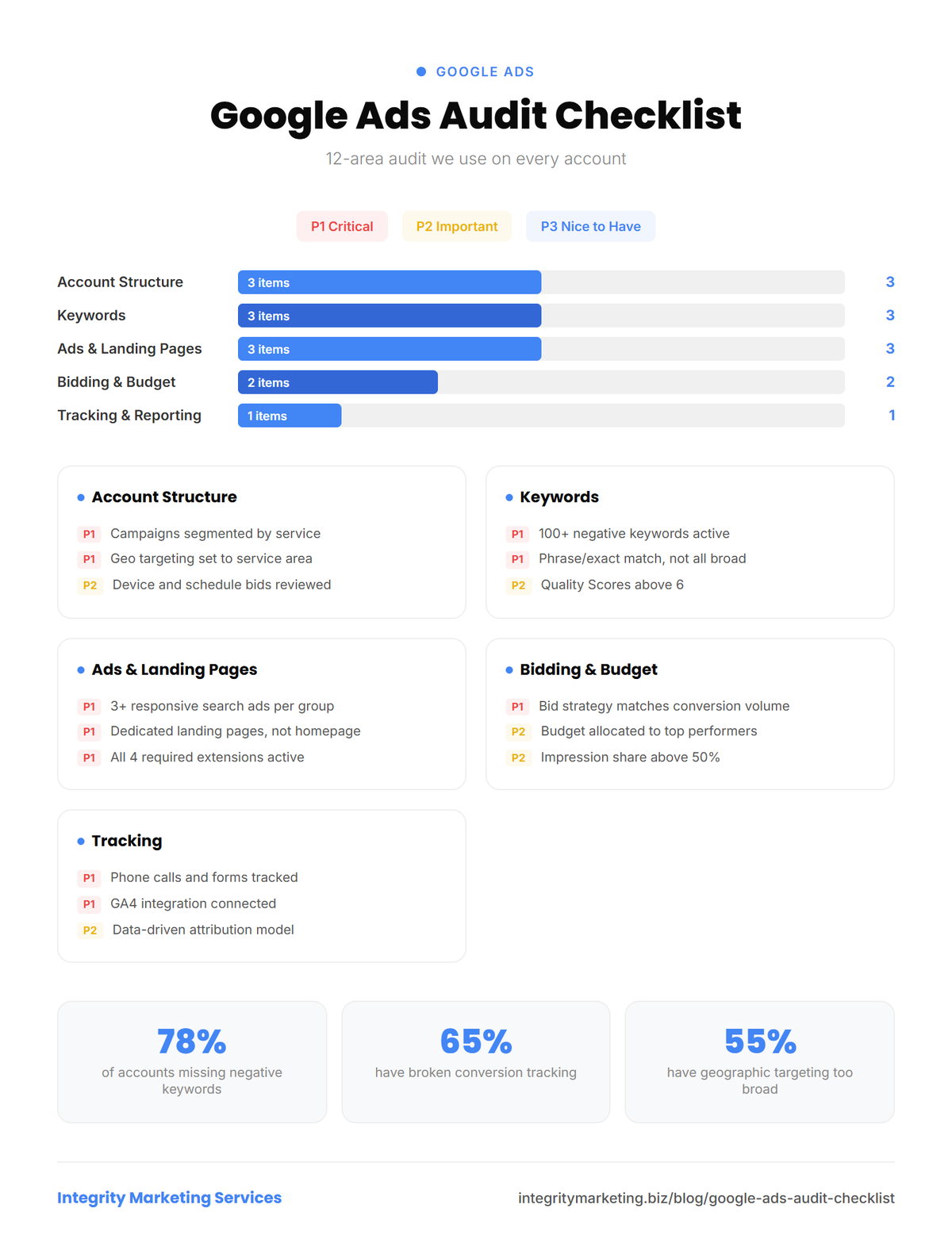
Account Structure (Areas 1-3)
1. Campaign Organization
Your campaigns should be organized by service type or business goal. Each campaign should have a clear theme, and ad groups within it should be tightly focused (5-15 keywords each).
Pass: Campaigns named descriptively (e.g., "Roof Repair - Seattle"), ad groups with 5-15 related keywords.
Fail: One campaign with everything in it, ad groups with 50+ keywords, or default campaign names.
2. Geographic Targeting
Your ads should only show in areas you serve. Check Settings > Locations for each campaign.
Pass: Targeting your specific service area by city, ZIP code, or radius. Location option set to "Presence" not "Presence or Interest."
Fail: Targeting the entire state or country. Using "Presence or Interest" (which shows ads to people interested in your area but not physically there).
3. Device and Schedule Settings
Review performance by device (mobile, desktop, tablet) and time of day. Adjust bids based on where leads actually come from.
Pass: Bid adjustments set based on performance data. Higher bids during business hours when phones are answered.
Fail: Default settings everywhere with no data-based adjustments.
Keywords (Areas 4-6)
4. Negative Keyword Strategy
Negative keyword list: Your account should have 50+ negative keywords organized by list. Without them, or with under 20, you are paying for irrelevant clicks.
Search term reviews: New negative keywords should be added at least every 30 days. If the last addition was 60+ days ago, waste is accumulating.
Industry-specific negatives: Common waste terms (jobs, schools, DIY, free) should be blocked. Check your search terms report for obvious irrelevant queries.
5. Match Type Strategy
Review the match types used across your keywords. A healthy account uses a mix of phrase and exact match, with broad match used strategically only when paired with smart bidding and sufficient conversion data.
Pass: Phrase and exact match keywords for core services. Broad match only where there are 30+ monthly conversions to support it.
Fail: All keywords set to broad match. No match type strategy visible.
6. Quality Score Monitoring
Quality Score (1-10) measures how relevant your ads and landing pages are to search queries. Higher scores mean lower costs per click.
Pass: Most keywords at 6 or above. High-value keywords at 7+.
Fail: Multiple keywords below 5. No Quality Score tracking.
Ads (Areas 7-9)
7. Ad Copy Testing
You should always have multiple ad variations running to test which messaging converts best.
Pass: 2-3 responsive search ads per ad group with varied headline and description options. Ads updated in the last 90 days.
Fail: One ad per ad group. Same ad copy running for 6+ months.
8. Ad Extensions (Assets)
Extensions increase your ad's visibility and click-through rate at no extra cost. Google uses extensions to make your ad larger and more informative, which pushes competitors further down the page. Accounts that use all relevant extensions typically see 10-20% higher click-through rates. There is no reason not to use them.
The four required extensions below should be active on every campaign. Structured snippets are recommended because they list your specific services directly in the ad.
Sitelinks
Links to specific pages on your site
Callout extensions
Highlight key benefits (Free Estimates, Licensed)
Call extension
Shows phone number in the ad
Location extension
Shows your business address
Structured snippets
Lists services or features
9. Landing Page Alignment
Each ad group should send traffic to a landing page that matches the search intent and ad copy.
Pass: Dedicated landing pages per service. Headlines match ad copy. Clear call to action visible above the fold.
Fail: All ads going to homepage. No CTA above fold. Slow load time (3+ seconds).
Bidding and Budget (Areas 10-11)
10. Bid Strategy Selection
The right bid strategy depends on your conversion data volume. Manual CPC works for new accounts. Smart bidding (Target CPA, Maximize Conversions) works better with 30+ monthly conversions.
Pass: Bid strategy appropriate for conversion volume. Performance reviewed and adjusted monthly.
Fail: Smart bidding on an account with fewer than 15 conversions per month. Or manual bidding on a mature account with ample data.
11. Budget Pacing and Allocation
Budget should be allocated to top-performing campaigns, not split evenly regardless of results. This is one of the most common and costly mistakes we see: a business runs three campaigns and gives each one a third of the budget, even though one campaign generates leads at $80 and another at $300. The efficient campaign is starved while the expensive one wastes money.
Check your impression share for each campaign. Impression share tells you how often your ads appear compared to how often they could appear. If your best-performing campaign has an impression share below 50%, it is losing opportunities because the budget is too thin. Move money from underperforming campaigns to feed the ones that are working.
Pass: Higher budgets on campaigns with the best cost per lead. Impression share above 50% for top campaigns.
Fail: Equal budgets across all campaigns. Impression share below 30% on best-performing campaigns (budget is too thin).
Tracking and Reporting (Area 12)
12. Conversion Tracking Setup
This is the foundation everything else depends on. If your tracking is broken, your optimization is meaningless.
Google Ads conversion tracking: Should be active and recording conversions. If not set up or showing zero conversions, all your optimization decisions are based on guesses.
Phone call tracking: Use a call tracking number with recording. Relying on just your website number means you cannot attribute calls to specific campaigns.
Form submission tracking: An event should fire on the thank-you page or on form submit. Tracking all page views as conversions inflates your numbers and misleads bidding algorithms.
GA4 integration: Should be connected with events flowing. If still using Universal Analytics only, you are missing data.
Attribution model: Use data-driven or position-based attribution. Last-click only gives all credit to the final touchpoint and undervalues awareness campaigns.
How to Score Your Audit
Add up your passes across all 12 areas. Each "pass" counts as one point. Your total score tells you how well your account is managed and where to focus your optimization effort. Most accounts we audit score between 4 and 7, which means there is almost always room to improve.
10-12
Excellent
Well-managed. Focus on scaling.
7-9
Good
Solid foundation. Fix failed areas.
4-6
Needs Work
Significant waste likely. Get an audit.
0-3
Critical
Major issues. Account rebuild needed.
"The most common reaction we get after walking a client through their first audit is disbelief. They had been told everything was fine. Then we show them the search terms their money has been going to, the missing conversion tracking, and the geographic waste. It is an eye-opener." - Leo Speaks, Sr. Account Manager
If your account scored below 7, or if you would rather have professionals do this, request a free Google Ads audit from our team. We will review your account and show you exactly where the waste is.
Free Tools and Resources
These free tools can help you audit your Google Ads account. We are not affiliated with any of them.
- Google Ads Performance Grader by WordStream — Free tool that gives your account a quick health score across key areas.
- Google Ads Editor — Free desktop app useful for reviewing account structure and making bulk changes during an audit.
- Google Tag Assistant — Free tool to verify your conversion tracking tags are firing correctly.
Frequently Asked Questions
How often should I audit my Google Ads account?
Full audits should happen quarterly. Ongoing optimization (search terms, bid adjustments, ad testing) should happen weekly. If you switch agencies, run a full audit on day one.
Can I audit my own Google Ads account?
Yes, using this checklist. You need admin access to your Google Ads account and basic familiarity with the interface. For deeper analysis (wasted spend calculations, Quality Score optimization, bid strategy evaluation), a professional audit adds more value.
What is the most common problem found in Google Ads audits?
Missing negative keywords. We find it in 78% of accounts. It is also one of the easiest problems to fix, which makes it especially frustrating when it has been ignored for months or years.
How long does a Google Ads audit take?
A self-audit using this checklist takes 1-2 hours. A professional audit with detailed analysis and recommendations takes 4-8 hours of analyst time, with results typically delivered within one week.
Should I pause my ads during an audit?
No. Keep ads running during the audit so we can see live performance data, search terms, and conversion patterns. Pausing hides the problems we need to find.
What happens after a Google Ads audit?
You receive a report with specific findings and prioritized recommendations. The highest-impact fixes (typically negative keywords, conversion tracking, and geographic targeting) can be implemented within the first week. Most clients see measurable improvement within 30 days of implementing audit recommendations.
Stop wasting ad spend
Want to know if your Google Ads are working?
We audit over 100 accounts a year and find an average of 25% wasted spend. Get a free audit and see where your budget is really going.